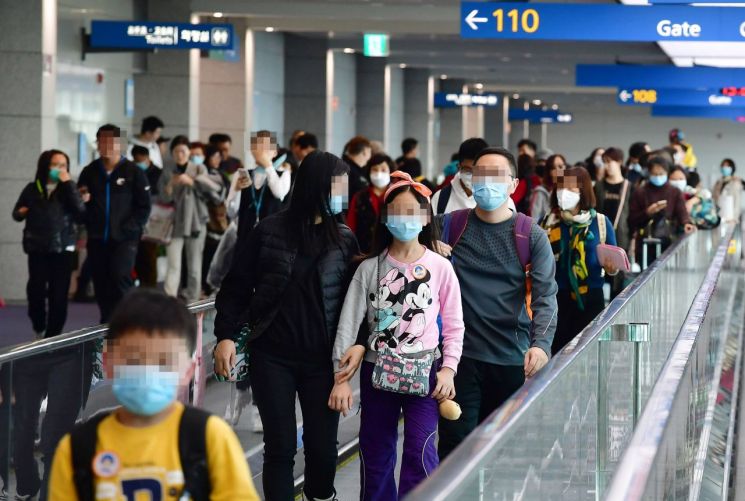
 As the number of deaths from the novel coronavirus 'Wuhan pneumonia' rapidly increases in China, passengers are seen walking wearing masks at Incheon International Airport on the 23rd.
 [Asia Economy Reporter Choi Dae-yeol] From now on, all travelers entering South Korea from China must fill out and submit a health status questionnaire, and if they exhibit symptoms such as fever, they must undergo separate quarantine inspections. Previously, this applied only to those arriving on direct flights from Wuhan, but this measure has been expanded due to the increased possibility of the novel coronavirus infection, known as 'Wuhan pneumonia,' entering the country.
The Korea Centers for Disease Control and Prevention (KCDC) announced on the 26th that starting from the 28th, the entire territory of China will be designated as a quarantine target contaminated area. A contaminated area refers to a region where a quarantinable infectious disease has occurred and is designated according to related regulations. Previously, 65 countries worldwide, including Wuhan City, were designated. In China’s case, Guangdong Province, Yunnan Province, Jiangsu Province, and Hunan Province were designated due to avian influenza (AI) human infections, and only Wuhan City was designated for Wuhan pneumonia. From now on, the entire region of China will be subject to this designation.
Health Authorities Designate Entire China as Contaminated Area
Submission of Health Status Questionnaire and Strengthened One-on-One Quarantine
Travelers entering from contaminated areas must fill out and submit a health status questionnaire. They must report the countries visited in the past three weeks before entry, check for symptoms such as fever, vomiting, sore throat, and cough, and indicate the areas where they will stay in South Korea. If symptoms such as fever are present, they will undergo quarantine inspection. Suspected cases will be immediately isolated or linked to the relevant local government for strengthened management based on the epidemiologist’s judgment.
The first confirmed domestic case of the novel coronavirus was a Chinese woman residing in Wuhan who was classified as symptomatic and transferred and isolated immediately after undergoing quarantine inspection upon disembarking the plane. The second confirmed case had been in Wuhan and entered the country via Shanghai but was classified as a subject of active monitoring without undergoing such procedures and was monitored by phone through the local health center before being confirmed positive.
This means that from now on, all entrants from China will undergo strict quarantine procedures. Jeong Eun-kyung, director of the KCDC, said, "We plan to deploy about 200 additional quarantine personnel supported by the Ministry of National Defense, the National Police Agency, and local governments," adding, "The time required for entry from China is expected to increase significantly."

Case definitions will also be revised so that frontline medical institutions can respond more quickly. Case definitions define the subjects requiring infectious disease surveillance, response, and management, and they change according to the characteristics of the pathogen or the pattern of occurrence for new infectious diseases. Until now, visitors to Wuhan City who showed pneumonia or suspected pneumonia symptoms were classified as suspected cases, but this will be expanded to include the entire Hubei Province, including Wuhan City. Anyone with either fever or respiratory symptoms will be immediately classified as a suspected case.
Visitors to other regions of China excluding Hubei Province who are diagnosed with pneumonia will be included as symptomatic subjects for investigation and isolated. If they have both fever and respiratory symptoms simultaneously, they will be managed by self-quarantine or active monitoring based on the epidemiologist’s judgment. Director Jeong Eun-kyung emphasized, "Expanding the quarantine target contaminated areas and changing case definitions will significantly increase the number of surveillance subjects. Local governments must proactively respond by expanding screening clinics or isolation hospitals and actively mobilizing personnel and facilities for surveillance and isolation management to prevent community spread."
© The Asia Business Daily(www.asiae.co.kr). All rights reserved.
![Clutching a Stolen Dior Bag, Saying "I Hate Being Poor but Real"... The Grotesque Con of a "Human Knockoff" [Slate]](https://cwcontent.asiae.co.kr/asiaresize/183/2026021902243444107_1771435474.jpg)

















