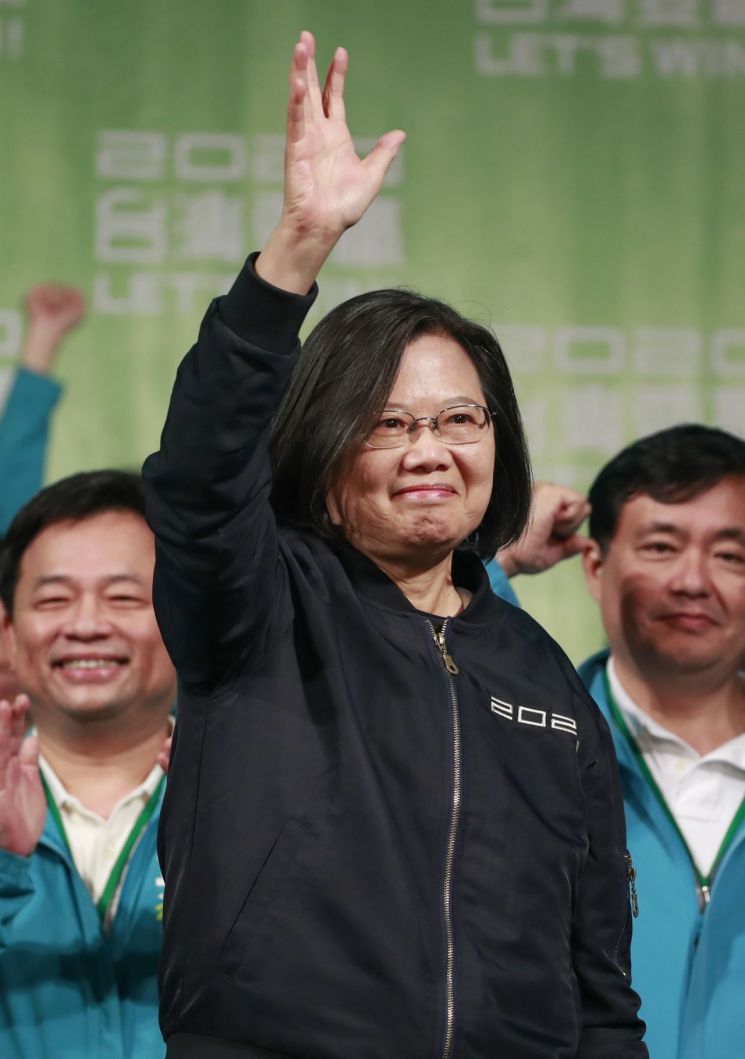
[Asia Economy Reporter Kim Hyunjung] On the 11th, after Tsai Ing-wen's successful re-election as Taiwan's president, it is expected that her government will accelerate the New Southbound Policy, competing with the Moon Jae-in administration's New Southern Policy.
The Korea Institute for International Economic Policy (KIEP) published a report titled "Prospects and Implications for Cross-Strait Relations after the 2020 Taiwan Election" on the 23rd, stating, "The Tsai Ing-wen administration is expected to further strengthen the promotion of the 'New Southbound Policy' to reduce high economic dependence on China and diversify export markets, which will form a competitive relationship with South Korea's New Southern Policy."
The target countries of the New Southbound Policy include 10 Southeast Asian countries, 6 South Asian countries (India, Pakistan, Bangladesh, Nepal, Sri Lanka, Bhutan), and 2 Oceania countries (Australia, New Zealand), which significantly overlap with South Korea's New Southern Policy target countries, suggesting potential competition in these countries.
Taiwan has already established a large-scale integrated agricultural complex in Indonesia through the New Southbound Policy, and six major general hospitals representing Taiwan are collaborating with medical institutions in six ASEAN countries on various cooperative projects. Additionally, in Vietnam, industrial land companies and small motor manufacturers, in Indonesia, tire makers, in the Philippines, electronics companies, and in India, injection molding machine companies have established local production bases.
Furthermore, the number of international students from Southeast Asia, which had been declining since peaking in 2008, has shown an increasing trend over the past three years. In 2017, the number of tourists from New Southbound Policy target countries visiting Taiwan reached 2,284,000, showing a 27.63% increase compared to the previous year.
Along with this, Taiwan's economic policy to diversify trade in order to improve its trade relationship, which is heavily dependent on China, is seen as a good business opportunity that could activate bilateral trade between South Korea and Taiwan. The deterioration of cross-strait relations delays the synergy effects of cross-strait economic cooperation and may negatively impact China's industrial competitiveness. Therefore, this could be an opportunity for South Korean companies competing with China in relevant industries.
The report also diagnosed that if the US-China competition over the Taiwan issue intensifies sharply, economic risks due to regional instability may arise, and it is necessary to prepare and respond to foreseeable scenarios in advance.
© The Asia Business Daily(www.asiae.co.kr). All rights reserved.
![Clutching a Stolen Dior Bag, Saying "I Hate Being Poor but Real"... The Grotesque Con of a "Human Knockoff" [Slate]](https://cwcontent.asiae.co.kr/asiaresize/183/2026021902243444107_1771435474.jpg)
















