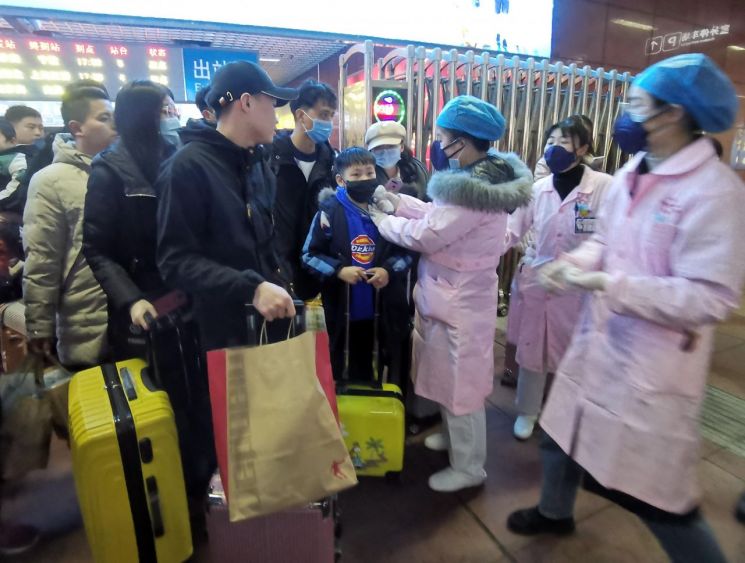
[Asia Economy Beijing=Special Correspondent Park Sun-mi, Reporter Jung Hyun-jin] The lockdown of Wuhan City, Hubei Province, which began at 10 a.m. on the 23rd, is the strongest response measure taken by Chinese authorities to prevent the spread of the novel coronavirus. It is interpreted as a strong expression of determination to prevent a recurrence of the 2003 Severe Acute Respiratory Syndrome (SARS) crisis, which paralyzed the entire country due to initial response failures.
According to sources on the 23rd, control within Wuhan, the epicenter of the 'Wuhan pneumonia,' had so far been concentrated only around the Wuhan Huanan Seafood Market, where confirmed cases surged. Although police cordons were set up around the market, which had already been disinfected and closed, blocking citizens' access, the market is located next to a main road and surrounded by many shops, leading to criticism that the blockade was not perfect.
This city lockdown measure came just three days after Wuhan pneumonia was classified as a legally notifiable infectious disease under full national control, indicating that China is taking the matter very seriously. Wuhan's area is larger than New York and London, with a population exceeding 11 million. It is a central inland transportation hub through which all railway networks in China pass, as well as a major commercial and industrial city. Moreover, the massive Spring Festival travel period (January 24-30), during which 3 billion trips are made annually, has already begun. The lockdown announcement was posted around 3 a.m. on the 23rd, reflecting concerns that if the initial lockdown failed, confirmed cases would spread rapidly.
During the 2003 SARS outbreak, some major cities like Beijing and Shanghai issued school closures and closed major buildings, shops, and roads connecting cities, but public transportation across entire cities was never shut down. Learning from the failed initial response to SARS, the calculation is to prevent virus spread from the outset with the strongest city lockdown measures.
As Wuhan pneumonia rapidly spreads worldwide, governments around the globe are responding by restricting their citizens' travel to and from Wuhan. Major U.S. companies have suspended business trips to Wuhan. According to CNBC, U.S. automaker General Motors (GM) issued a statement on the day announcing a temporary restriction on employee business trips to Wuhan, China. Ford also stated, "All business trips to Wuhan are suspended," adding, "We are closely monitoring the situation." Fiat Chrysler has not yet restricted trips but has instructed employees traveling to China to perform only essential duties.
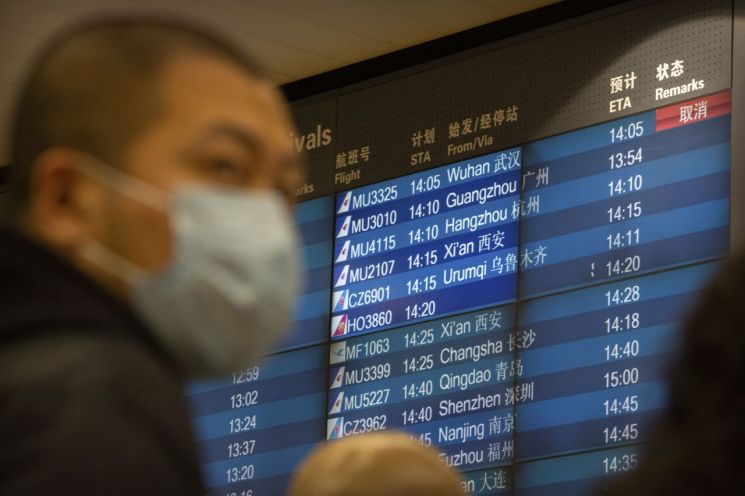
For airlines, anxiety is even greater. As countries worldwide strengthen airport quarantine measures, Russia, Singapore, and Saudi Arabia have decided to screen all passengers arriving from China for possible infection. The Association of Flight Attendants (AFA), representing crew members from 20 U.S. airlines, requested that airlines take preemptive measures for their flight attendants. The Air Line Pilots Association (ALPA) also distributed information about the novel coronavirus infection received from U.S. and other health authorities to its members. Norwegian Cruise Line, a U.S.-based cruise operator, is monitoring passengers departing from Chinese ports and is not allowing boarding to those who have visited Wuhan within the past 30 days.
Japanese companies have also taken measures such as banning local business trips to China. Japanese automaker Honda, for example, prohibited business trips to Wuhan for all employees worldwide as of the previous day. Wuhan hosts the office and factory functioning as the headquarters of Dongfeng Honda, a joint venture with a Chinese company, employing about 12,600 people. Honda explained that although no infections have been reported among local employees, the decision was made considering the overall situation.
Mitsubishi Chemical Holdings instructed its subsidiaries, including Mitsubishi Chemical and Tanabe Mitsubishi Pharma, to avoid business trips to Wuhan and surrounding areas unless urgent. Other companies such as Nippon Steel, JFE Steel, and Kobe Steel are reported to have issued similar instructions. Aeon, which operates large supermarkets in Wuhan, has strengthened infection prevention measures and instructed employees to report any abnormalities immediately.
The Japanese retail industry is wary of the possibility of Wuhan pneumonia entering the country. Shigeki Yamazaki, Executive Director of the Japan Department Stores Association, said the previous day, "Since the spread is ongoing, it would be good to conduct thorough inspections upon entry."
NHK reported that Chinese authorities suspended flights at Wuhan Airport starting at 10 a.m. on the 23rd, and All Nippon Airways (ANA) flights connecting Wuhan and Japan's Narita Airport are expected to be canceled. At Narita Airport, Chinese travelers preparing to depart were seen purchasing masks in large quantities. This is interpreted as panic buying to prevent infection amid growing concerns about Wuhan pneumonia in China.
Meanwhile, the World Health Organization (WHO) planned to decide on the 23rd (local time) whether to declare an international public health emergency over the novel coronavirus outbreak originating in Wuhan, China. If declared, countries would be advised to refrain from trade and travel with the affected nation, raising concerns about the global economic impact. The current influence of the Chinese economy on global markets is greater than during the 2003 SARS outbreak. Notably, copper prices, considered a leading economic indicator and nicknamed 'Dr. Copper,' fell 0.88%, hitting their lowest level since the 3rd of this month. International oil prices also dropped nearly 3%, signaling market reactions anticipating a downturn in the real economy.
However, some argue that economic damage may be temporary, citing the SARS case. Jennifer McKeown, Head of Global Economic Services at Capital Economics, stated, "The significant economic disruption related to SARS proved to be temporary," adding, "Experts expect this disease to be less fatal and better contained."
© The Asia Business Daily(www.asiae.co.kr). All rights reserved.


















