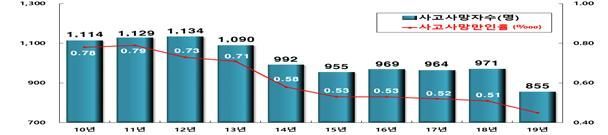
[Asia Economy Reporter Kim Hyunjung] Last year, the number of industrial accident fatalities dropped to the lowest level ever recorded, and the government is focusing on reducing this number to below 600 by 2022. Building on last year’s achievements, there is a growing momentum to accelerate efforts by strengthening the management of severe industrial accidents and increasing on-site inspections. However, there are calls for a highly autonomous separate agency dedicated to this priority task to address industrial accident issues more systematically.
According to the Korea Occupational Safety and Health Agency on the 24th, the government has reached a consensus on the goal of reducing industrial accident fatalities to the 600 range this year and plans to strengthen related management and on-site inspections. Following a decrease of 116 fatalities (11.9%) from the previous year to 855 last year, the government plans to focus its efforts on expanding the reduction to 160 fatalities this year.
The Korea Occupational Safety and Health Agency has decided to promote industrial accident prevention projects this year with the goal of reducing industrial accident fatalities to the 600 range and achieving a fatality rate of 0.39 per 10,000 workers. The fatality rate refers to the ratio of work-related accident deaths per 10,000 workers in a year.
In particular, patrol inspections, which were found to be highly effective in reducing industrial accident fatalities last year, will be organized as a regular project with significant improvements in its content. A “selection and concentration” strategy has been adopted in this process. Priority will be given to preventing fall accidents in the construction industry and improving fall and entrapment risk factors in the manufacturing sector, where the proportion of fatalities is high. Additionally, safety facility subsidies supporting fall accident prevention at small construction sites have been allocated 55.4 billion KRW this year, an increase of 20.2 billion KRW (57.3%) compared to last year’s 35.2 billion KRW.
Some voices argue that an independent agency is necessary to manage industrial accident issues effectively. Similar to the Korea Occupational Safety and Health Agency, such an agency should have a commissioner who oversees relevant affairs and holds command and supervisory authority over affiliated officials. This would allow the agency to operate and execute independently with mid- to long-term tasks, even if political interest in industrial accident issues wanes depending on circumstances.
In fact, the Employment and Labor Administration Reform Committee, which functions as a committee to eliminate deep-rooted problems within the Ministry of Employment and Labor, recommended last year the establishment of an “Industrial Safety and Health Agency” as a specialized administrative organization in the field of industrial safety and health. The committee pointed out that superficial labor inspections and formal accident prevention measures could exacerbate industrial accidents. However, related discussions have not been actively pursued to date.
© The Asia Business Daily(www.asiae.co.kr). All rights reserved.
![Clutching a Stolen Dior Bag, Saying "I Hate Being Poor but Real"... The Grotesque Con of a "Human Knockoff" [Slate]](https://cwcontent.asiae.co.kr/asiaresize/183/2026021902243444107_1771435474.jpg)
















