[Asia Economy Reporter Jang Sehee] The government has set this year's economic growth rate (real GDP) at 2.4%, up 0.39 percentage points from last year's 2.01%.
This outlook is based on expectations that domestic demand will expand due to revitalized investment and that exports, which had been declining, will improve.
In particular, the 'expansionary super budget' is expected to act as a breakwater against external shocks, breaking the stagnation of low growth and rekindling the spark of economic recovery. However, there is a significant gap between the government and the market's views.
The government's optimistic forecast has repeatedly been revised downward every year, and despite these misjudgments, the government blamed external factors rather than policy errors. This is also analyzed as the reason why even private and national research institutes have issued completely opposite assessments this year. However, experts point out that the 2.4% growth forecast is overly optimistic.
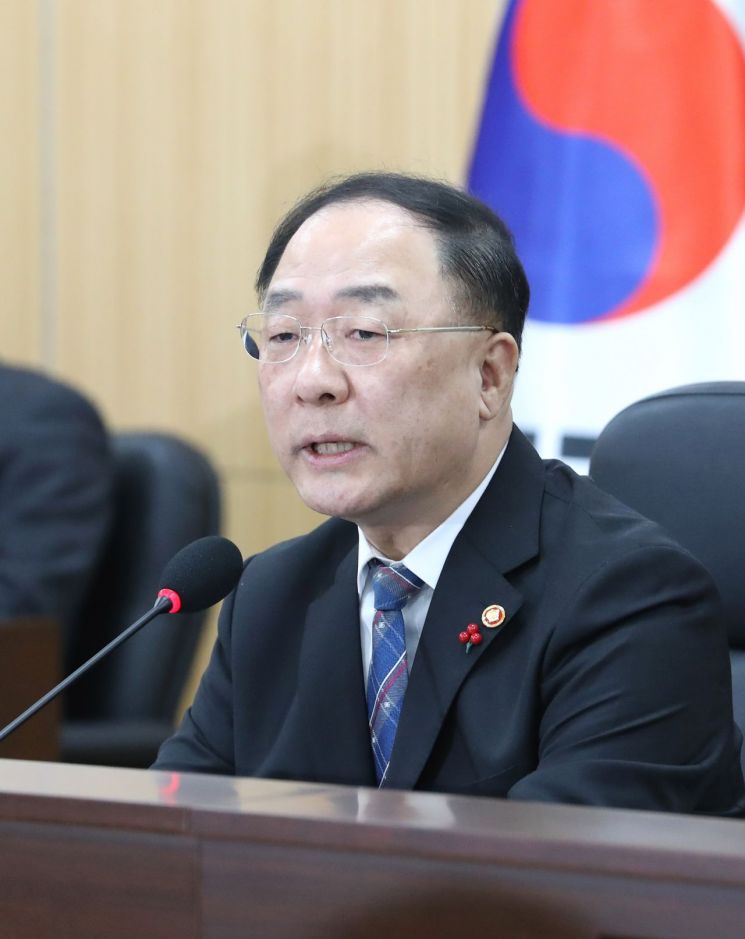
◆ Moon Administration Aiming for Economic Rebound = On the 22nd, Deputy Prime Minister and Minister of Strategy and Finance Hong Nam-ki said regarding last year's growth rate, "Although the annual 2% growth fell short of expectations, it maintained the market's psychological margin and became an opportunity to gain confidence in laying the groundwork for an economic rebound." He added, "This year, through a 100 trillion won investment project, the era of 20 million inbound tourists, and the spread of the second venture boom, we will go all-in to enhance private sector vitality and the dynamism of our economy to surely achieve 2.4% growth."
The government cited the resolution of uncertainties from the US-China trade conflict, signs of global economic bottoming out, and semiconductor industry recovery as the basis for a better growth forecast than last year. It also expects exports, which retreated throughout last year, to increase by 3% this year. Additionally, facility investment is projected to rise by 5.2%, supported by a rebound in the semiconductor and information and communication technology (IT) sectors. Private consumption is also expected to grow by 2.1%, according to the government's outlook. However, although some uncertainties were alleviated by the Phase One US-China trade agreement, risks from external conditions remain, as trade disputes could reignite at any time. There is also the possibility of a US-European Union (EU) trade conflict instead of the US-China dispute.
Furthermore, the International Monetary Fund (IMF) presented a global economic growth rate of 3.3% for this year in its 'World Economic Outlook' released at the Swiss Davos Forum. This figure is 0.1 percentage points lower than the forecast made three months ago. The IMF has steadily lowered its 2020 growth forecasts from 3.6% (April last year), 3.5% (July last year), to 3.4% (October last year). It also lowered next year's growth forecast from 3.6% to 3.4%, a 0.2 percentage point drop. Although the global growth rate, which fell from 3.6% in 2018 to 2.9% last year, is expected to attempt a rebound this year, the outlook is increasingly pessimistic regarding the strength of recovery. IMF Managing Director Kristalina Georgieva stated at a press conference, "Global growth remains sluggish," adding, "We have not yet reached a turning point."
Exports, in particular, have continued to decline this year. According to the Korea Customs Service, exports from the 1st to the 20th of this month amounted to $25.7 billion, down 0.2% ($40 million) compared to the same period last year. If the decline continues until the end of this month, exports will have fallen for 14 consecutive months since 2018.
The government's optimistic outlook is criticized as stemming from a misjudgment of the situation. In the 'Economic Conditions Assessment' section of last year's economic policy direction, the government stated, "We accelerated the structural transformation of our economy amid the global economic slowdown." This is a self-assessment that last year's economic conditions were poor due to external factors rather than policy errors. Moreover, the government has repeatedly lowered its growth rate forecasts annually. The growth forecast for last year, announced by the government in December 2018, was 2.6?2.7%, but it was lowered by 0.6?0.7% to 2.0%.
Morgan Stanley and LG Economic Research Institute forecast South Korea's growth rate this year at 1.7% and 1.8%, respectively. The Korea Development Institute (KDI) also projects a lower 2.3% than the government.
◆ Exports and Facility Investment Also Plummeting = Experts unanimously point out that the government's perception of the situation is incorrect. Professor Shin Se-don of Sookmyung Women's University’s Department of Economics said, "With private consumption declining, achieving 2.4% growth will be difficult," adding, "Exports are becoming a factor that eats into growth as they worsen, and with exports down, facility investment dies. If a global crisis spreads, the growth rate could fall below even 1%, let alone 2%."
He continued, "Ultimately, measures to enhance flexibility in labor policies such as the minimum wage and the 52-hour workweek system must be prepared," emphasizing, "Many factors burden companies, causing significant damage to national competitiveness."
Professor Lee In-ho of Seoul National University’s Department of Economics also said, "Growth should come from the private sector, but it seems the government will try to drive the economy through fiscal spending," expressing regret, "The government cannot keep growing the economy with money indefinitely." He advised that achieving the target growth rate would be difficult if vitality does not emerge in private sectors such as consumption. He diagnosed, "Because the economy is difficult, idle funds have exceeded 1,000 trillion won. Although the government managed to achieve 2.0%, there is no clear factor to push it up to 2.4%."
© The Asia Business Daily(www.asiae.co.kr). All rights reserved.

















