The Bank of Korea: "Unusually High Demand for Seollal New Year's Money"
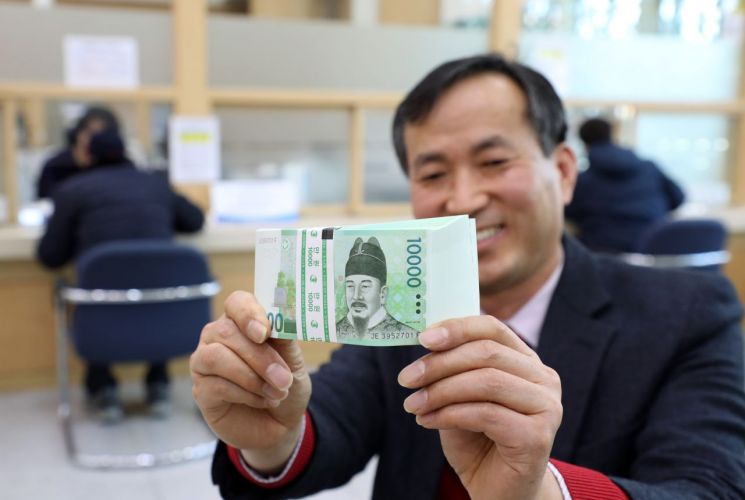
[Asia Economy Reporter Kim Eun-byeol] Ahead of the Lunar New Year holiday, the demand for New Year's money gifts (Sebae money) increased, resulting in a 20.0% rise in the number of currency exchanges through the Bank of Korea's issuing office counters compared to the previous year.
According to the "2020 Lunar New Year Holiday Currency Supply Performance" announced by the Bank of Korea on the 23rd, the number of currency exchanges by the general public through the issuing office counters during the 10 business days before the holiday reached 7,090 cases. This is a 20.0% increase compared to last year. The number of currency exchanges before the Lunar New Year holiday was 5,955 cases in 2018 and 5,908 cases in 2019. The Bank of Korea explained, "The demand for Sebae money during the Lunar New Year was unusually high."
The funds supplied by the Bank of Korea for the holiday also increased by 1.0% compared to the previous year, totaling approximately 5.5953 trillion KRW.
From the 10th to the 23rd of this month, the net issuance (issuance amount minus redemption amount) supplied through financial institutions was approximately 5.5953 trillion KRW. This represents a 1.0% increase compared to 5.5381 trillion KRW last year. This year, the issuance amount was 6.0896 trillion KRW, an increase of about 1.0%, and the redemption amount was 494.3 billion KRW, up 0.3%.
The Bank of Korea explained, "Despite the Lunar New Year holiday period shortening from 5 days to 4 days compared to last year, the demand for corporate payroll and Lunar New Year bonuses, as well as household Sebae money demand, significantly increased compared to last year, which mainly influenced the rise."
By region, net issuance increased sharply compared to the previous year mainly in the issuing offices overseeing Seoul and the metropolitan area (15.5%) and Jeju Headquarters (10.8%), while it generally decreased in Incheon Headquarters (-18.2%) and Daegu-Gyeongbuk Headquarters (-9.8%).
© The Asia Business Daily(www.asiae.co.kr). All rights reserved.
![Clutching a Stolen Dior Bag, Saying "I Hate Being Poor but Real"... The Grotesque Con of a "Human Knockoff" [Slate]](https://cwcontent.asiae.co.kr/asiaresize/183/2026021902243444107_1771435474.jpg)











