Massive Influx of Chinese Population During Migration Period... Domestic Arrivals Surge Up to 3 Times
Domestic Health Authorities on High Alert, WHO Considers Declaring Emergency
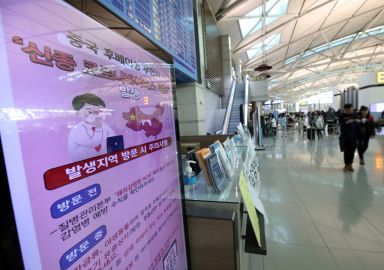
[Asia Economy Reporter Cho Hyun-ui] As the first confirmed case of coronavirus infection (Wuhan pneumonia) in Korea has emerged, health authorities are viewing the Lunar New Year holiday as the first critical period. During the Chinese New Year (Chunjeol, 春節), the largest holiday in China, the number of arrivals from China increases by 2 to 3 times compared to usual.
A representative from the Korea Centers for Disease Control and Prevention (KCDC) said on the 23rd, "We are considering the Chunjeol period as the first risk period in terms of timing." Anticipating an increase in emergency room visits during the Lunar New Year holiday, health authorities have distributed guidelines for responding to visiting patients and have required verification of overseas travel history during the initial screening process.
During the Chunjeol holiday period, when 3 billion people in China travel, the number of Chinese arrivals visiting Korea is expected to reach 100,000. The problem is that not only arrivals from Wuhan, Hubei Province?the epicenter?but also those from all over China are not free from the fear of pneumonia. As of the previous day, confirmed cases were reported as follows: 444 in Hubei Province (including Wuhan City), 26 in Guangdong, 14 in Beijing, 10 in Zhejiang, 9 in Shanghai, and 44 in other regions.
With the possibility of human-to-human transmission being raised, the number of confirmed cases is expected to continue increasing. Park Hye-kyung, head of the KCDC Crisis Response and Terrorism Division, said, "Except for some peripheral provinces and cities in China, patients continue to occur, so there is a very high possibility of additional cases occurring even after the Lunar New Year holiday."
It is also crucial to see whether a 'super spreader'?a single confirmed patient who infects four or more people?will emerge, as was the case during the 2015 MERS outbreak. At that time, a total of five super spreaders infected 153 people, accounting for 83.2% of all patients.
Currently, the existence of a super spreader in China has not been officially confirmed and is only mentioned in expert interviews. Park explained, "We have not received information from Chinese authorities about who the patients have infected. The World Health Organization (WHO) also does not know the epidemiological details," adding, "Medical institutions in Korea are responding to prevent the occurrence of super spreaders domestically."
Meanwhile, the WHO is scheduled to decide on the declaration of an international emergency regarding Wuhan pneumonia on the same day (local time). An international emergency is a regulation used only for the most serious infectious diseases. If declared, recommendations to refrain from trade and travel with the affected countries will be communicated to each nation, and an international medical response system will be established.
© The Asia Business Daily(www.asiae.co.kr). All rights reserved.
![User Who Sold Erroneously Deposited Bitcoins to Repay Debt and Fund Entertainment... What Did the Supreme Court Decide in 2021? [Legal Issue Check]](https://cwcontent.asiae.co.kr/asiaresize/183/2026020910431234020_1770601391.png)















