Sungkyunkwan University Professor Bae Oesik's Research Team Discovers New Type of Immune Cell
Disruption of Reactive Oxygen Secretion Raises Mortality by Impairing Bacterial Defense
"Enables New Perspective on Bacterial Infection Response"
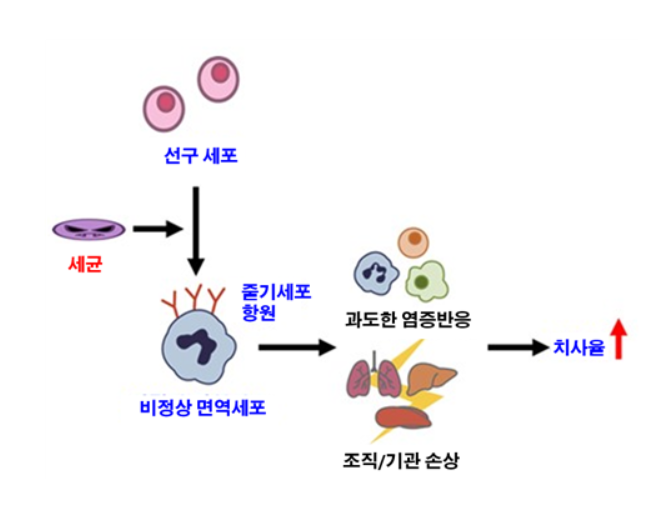 The in vivo mechanism of myeloid immune cells identified by Professor Bae Woesik's research team (Data provided by Professor Bae Woesik's research team, Sungkyunkwan University)
[Asia Economy Reporter Han Jinju] Faulty immune cells that differentiate into immune cells responsible for fighting bacteria but fail to perform their function have been observed.
On the 23rd, the National Research Foundation of Korea announced that Professor Bae Oesik's research team at Sungkyunkwan University discovered a new type of immune cell that worsens infection and affects mortality in mice infected with Staphylococcus aureus. This research achievement was also published in the international journal Science Advances.
The research team found that in a mouse model infected with Staphylococcus aureus, a glycoprotein secreted by neutrophils (immune cells that engulf bacteria within white blood cells) gathered at the bacterial infection site acts as a stimulant, leading to the generation of a new type of immune cell.
Sepsis has been known to start with an excessive inflammatory response followed by immune function paralysis, but the cells mediating this process had not been identified.
The newly discovered faulty immune cells are characterized by possessing stem cell antigen-1 on their surface, similar to undifferentiated hematopoietic stem cells, despite having completed differentiation.
The research team also found that these immune cells excessively secrete pro-inflammatory substances but fail to properly produce reactive oxygen species that eliminate bacteria.
When antibodies against the stem cell antigen on the surface of these cells were administered to remove the immune cells, tissue damage and mortality in bacteria-infected mice decreased. Conversely, transplanting these immune cells into infected mice increased tissue damage and mortality.
Professor Bae Oesik explained, "It is an interesting achievement in that we discovered a new type of immune cell that had not been identified before. Sepsis caused by bacteria is still considered a severe inflammatory response, and by discovering a new immune cell deeply involved in its mechanism, we can approach bacterial infection responses from a new perspective."
The National Research Foundation of Korea stated, "The new immune cells can be used as targets necessary for developing bacterial infection treatments," and added, "It is expected to be applicable in developing diagnostic and prognostic markers for bacterial infectious diseases."
© The Asia Business Daily(www.asiae.co.kr). All rights reserved.

















