Increased by 25.5 trillion won up to the 17th this year
Last year, increased by 19.4 trillion won throughout the year
[Asia Economy Reporter Koo Eun-mo] Domestic investment funds have been flowing into public offering funds this year. This is analyzed to be due to the 'early-year effect,' where funds recovered during the year-end settlement process are reinvested at the beginning of each year, as well as a reflex effect caused by recent consecutive trust issues that have caused private equity fund investments to slow down.
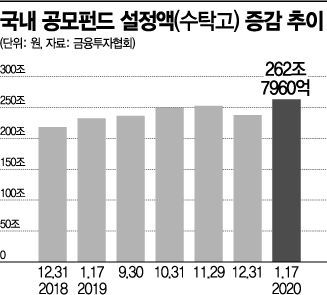
According to the Korea Financial Investment Association on the 22nd, as of the 17th, the domestic public offering fund assets under management (AUM) stood at 262.796 trillion KRW, an increase of 25.576 trillion KRW from 237.220 trillion KRW at the end of last year. Although public offering fund AUM decreased by 14.9108 trillion KRW in December last year, falling to around 230 trillion KRW, funds have been flowing in continuously since the beginning of this year, swelling the size to about 260 trillion KRW. Compared to the increase of 19.4442 trillion KRW from the end of 2018 (217.7785 trillion KRW) through last year, this is a rapid increase in a short period.
The recent increase in public offering fund AUM is basically attributed to the early-year effect, where AUM tends to increase at the beginning of each year. A Korea Financial Investment Association official explained, "Fund AUM generally decreases during the year-end settlement period but tends to increase after reinvestment processes at the beginning of the year."
However, this year's increase in public offering funds is relatively large, exceeding 10 trillion KRW more than the increase during the same period last year (1.40578 trillion KRW). The financial investment industry believes that the fund redemption suspension incident involving Lime Asset Management, the number one domestic private equity fund operator with about 1.5 trillion KRW in assets, affected investors' private equity fund investment sentiment, and as a reaction, some of the related funds flowed into public offering funds, which are considered relatively safer.
As trust issues regarding private equity funds have recently emerged one after another, the early-year growth trend of private equity funds seems to have slowed down somewhat. As of the 17th, domestic private equity fund AUM was 412.7515 trillion KRW, an increase of only 342.5 billion KRW from 412.409 trillion KRW at the end of last year. Compared to the average monthly increase of 6.6 trillion KRW throughout last year, the growth trend has clearly weakened. Domestic private equity fund AUM was 333.2194 trillion KRW at the end of 2018 and grew to 412.409 trillion KRW last year, increasing by more than 79 trillion KRW in one year.
It is pointed out that policy support is also necessary for investment in public offering funds to become more active. A Korea Financial Investment Association official said, "Providing long-term holding tax exemption benefits for public offering funds could revive the stock market, break the vicious cycle of funds flowing in when the market rises and out when it falls, and sustain continuous growth in AUM."
© The Asia Business Daily(www.asiae.co.kr). All rights reserved.

















