[Asia Economy Yang Nak-gyu Reporter] The Ministry of National Defense has decided to accelerate the acquisition of 'anti-drone' weapons. As drones emerge as 'spears,' the military naturally intends to speed up the development of 'shields' to defend against drones.
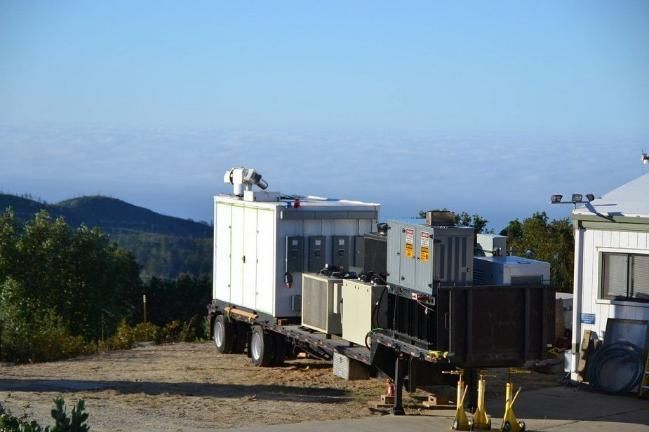
On the afternoon of the 21st, Defense Minister Jeong Kyeong-doo reported this plan during the '2020 Ministry of National Defense Work Report' held at Gyeryongdae, Chungnam, where the command headquarters of the Army, Navy, and Air Force are located, presided over by President Moon Jae-in, and showcased a laser anti-aircraft weapon, an anti-drone weapon.
This is the first public unveiling of the laser anti-aircraft weapon developed by the Agency for Defense Development (ADD) since 2016. The laser anti-aircraft weapon displayed that day is known to be a prototype.
The ADD is developing a laser anti-aircraft weapon to capture drones, with plans to operationalize it by 2023. The technology ADD is developing employs a 'hard kill' method that physically destroys drones. The laser anti-aircraft weapon, a hard kill type anti-drone technology, has the advantage of intercepting small drones at low cost. It focuses a laser beam on the vulnerable parts of the target, heating and then igniting it. ADD has secured the core technology for beam irradiation and has completed research to a level that is currently practical. ADD, which possesses system design capabilities, is reportedly focusing on system refinement and miniaturization while developing the weapon system.
However, the hard kill method requires direct beam irradiation on the drone, so interception is difficult if the drone is not visible or weather conditions such as rain are unfavorable.
Accordingly, the government is also proceeding with procedures to acquire soft kill weapons that disable drones through radio waves rather than laser irradiation. A representative soft kill method is 'jamming,' which disrupts radio communications or Global Positioning System (GPS) signals to prevent drones from reaching their intended targets. It disables drone control and GPS functions. This equipment is currently being pilot-operated by the Air Force's 20th Fighter Wing.
Countries around the world are already accelerating the development of systems to counter drone attacks. The militarization of drones has become a reality as major oil facilities and oil fields of Saudi Arabia's state-owned oil company Aramco, the world's largest oil company, were attacked by drones. Market research firm MarketsandMarkets predicted that the anti-drone market will grow from $499 million in 2018 to $2.276 billion by 2024.
Some countries have already operationalized anti-drone systems. The United Kingdom installed Israel's drone defense system 'Drone Dome' at airports. France also installed the 'Game Keeper' drone detection system made by the British company Aveillant. Incheon Airport and Gimpo Airport will introduce drone intrusion prevention systems by next year. These systems can detect drones flying within a 3 km radius of Terminals 1 and 2.
The anti-drone systems at airports worldwide have also accelerated the pace of defense companies.
Last November, American company Lockheed Martin demonstrated the ATHENA laser weapon system at a government test site in Fort Sill, Oklahoma. This weapon system proved its practicality by defending against attacks from multiple fixed-wing and rotary-wing drones. ATHENA detects drones through a command and control system and destroys them using a high-power laser. The U.S. Air Force explained that the ATHENA system is cost-effective because it uses networks already employed by combat personnel.
Among domestic defense companies, Hanwha Systems is notable. In October last year, Hanwha Systems exhibited a 'drone-dedicated surveillance sensor (radar)' at ADEX. The drone-dedicated surveillance sensor is a system that detects and tracks drones within 3 km using radar and an electro-optical sensor equipped with day and night cameras. The radar responsible for primary detection and tracking can detect ultra-slow drones that are nearly stationary, which were difficult to detect with existing military radars.
A government official explained, "Preparations for acquiring anti-drone weapons have been underway for a long time," adding, "As drone threats increase, it became necessary to secure new concept weapon systems that can respond effectively."
© The Asia Business Daily(www.asiae.co.kr). All rights reserved.
![Clutching a Stolen Dior Bag, Saying "I Hate Being Poor but Real"... The Grotesque Con of a "Human Knockoff" [Slate]](https://cwcontent.asiae.co.kr/asiaresize/183/2026021902243444107_1771435474.jpg)
















