Like During SARS, Too Little Too Late... Severe Economic Impact if Spread Occurs
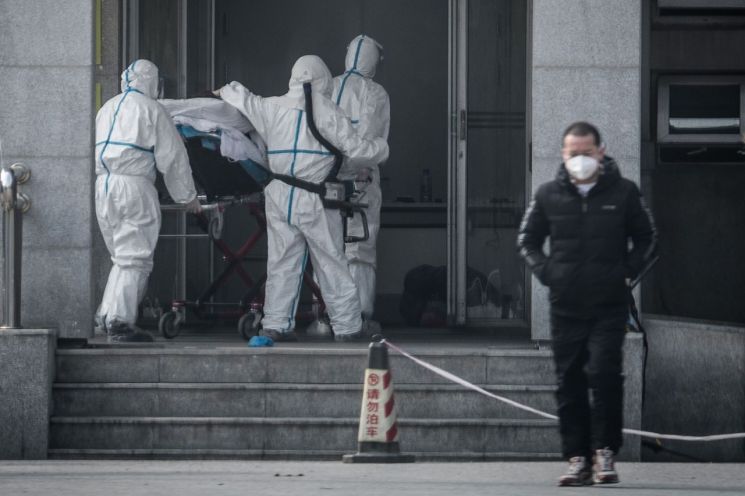
[Asia Economy Reporters Minyoung Kim and Hyunui Cho] Domestic health authorities have been inconsistent about the possibility of human-to-human transmission of the "Wuhan pneumonia," raising concerns about problems in information sharing with the Chinese government. There is criticism that the "health hotline" established for information sharing among South Korea, China, and Japan during infectious disease outbreaks did not function properly this time as well.
According to domestic health authorities on the 21st, the Korea Centers for Disease Control and Prevention (KCDC) initially assessed the possibility of human-to-human transmission as low based on announcements from Wuhan health authorities when the first suspected patient appeared on the 7th. Accordingly, the KCDC limited contact tracing to medical staff and workplace colleagues of the suspected patient. A KCDC official explained, "Since no human-to-human transmission cases had been found in China and others, and no infections were reported among medical staff who would be the first exposed if transmission were possible, contact tracing was limited accordingly."
◆ South Korea-China-Japan Health Hotline Fails Again = However, 13 days later, health authorities raised the infectious disease alert level to "caution," stating that human-to-human transmission is possible. The KCDC explained the change in stance as based on "information from China," but there are criticisms that our health authorities have been overly dependent on the Chinese government, which has been uncooperative in sharing information.
Minister of Health and Welfare Park Neung-hoo also acknowledged the practical limitations the day before, saying, "We trust the Chinese (government) announcements, but due to the nature of their system, it is possible they do not fully disclose information." This implicitly admits that the hotline established for information sharing among South Korea, China, and Japan during infectious disease outbreaks is not functioning properly.
The trilateral health hotline also failed during the plague outbreak in China last year. In November last year, when a plague patient was reported in Inner Mongolia, China, our government confirmed the case through the Korean Embassy in China rather than the hotline because the Chinese government did not provide any information via the hotline. Subsequently, at the South Korea-China-Japan Health Ministers' Meeting held in Seoul on December 14-15 last year, the three countries agreed to establish a hotline among agency heads to strengthen infectious disease response. However, the inconsistent judgments by health authorities regarding Wuhan pneumonia revealed that even the agency head hotline was not functioning.
A medical industry official pointed out, "Instead of making the hotline a mere formality, our side should strongly request cooperation from the Chinese government so that even the existing hotline can function properly."
◆ "Wuhan Pneumonia Spread Could Negatively Impact Our Economy" = Meanwhile, concerns are emerging that if Wuhan pneumonia spreads like Severe Acute Respiratory Syndrome (SARS) did worldwide in 2003, it could adversely affect South Korea's economy, including a decrease in gross domestic product (GDP). The Korea Institute for International Economic Policy (KIEP) estimated in its report titled "Current Status and Response Measures for the Unknown Pneumonia Originating from China," published on the 15th, that due to SARS, exports contracted in May 2003 (export growth rate 3.5%), causing South Korea's GDP growth rate in the second quarter to fall by about 1 percentage point (annual growth rate by about 0.25 percentage points).
There are also concerns about consumption contraction due to a decrease in tourists. In fact, the number of Chinese tourists, which was approximately 539,400 in 2002, decreased to about 512,700 in 2003 due to SARS. Recently, with the easing atmosphere of the Han-Han-ryeong (限韓令, Limit Korea Order), expectations for increased consumption of cosmetics and other goods have grown, but there is a possibility that Wuhan pneumonia could lead to a decrease in tourists and thus a contraction in consumption. The government mentioned in the "Recent Economic Trends (Green Book)" briefing that "the number of Chinese tourists in December increased by 26.9% compared to a year ago," and that the recovery of Chinese tourists is expected to positively affect retail sales.
© The Asia Business Daily(www.asiae.co.kr). All rights reserved.

















