[Asia Economy Reporter Jeong Hyunjin] As the 50th Annual Meeting of the World Economic Forum (WEF, Davos Forum) takes place from the 21st to the 24th, it has been revealed that half of the world’s business leaders expect the economy to worsen this year. They expressed concerns about trade conflicts and uncertainties regarding economic improvement, spreading the most pessimistic outlook since the survey began in 2012.
According to the economic outlook report released on the 20th (local time) by PwC Consulting, a survey conducted among 1,581 CEOs from 83 countries showed that 53% responded that the global economy is expected to deteriorate over the next 12 months. This is the highest level since the survey started in 2012. The percentage of respondents expecting economic decline was 5% in 2018, rose to 29% last year, and reached 53% this year.
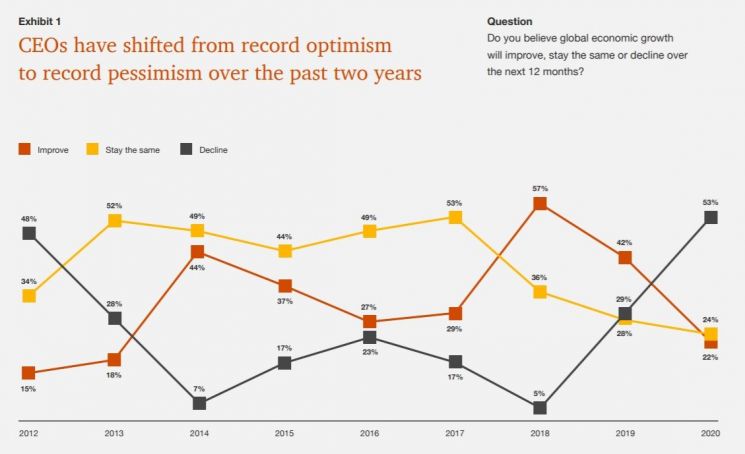
This aligns with the global economic growth forecast for this year released by the International Monetary Fund (IMF) on the same day. The IMF lowered its global economic growth forecast for this year by 0.1 percentage points from the previous estimate made three months ago, to 3.3%. According to the Washington Post (WP), Kristalina Georgieva, IMF Managing Director, said that recent social conditions remind her of the 1920s, which ended in catastrophe with the Great Depression. She cited record levels of inequality and rapid technological advancement, stating, "The start of this new decade strangely reminds me of the 1920s." She emphasized, "To halt these similarities, it is absolutely crucial to cooperate and act together."
Business leaders identified "excessive regulation" as the greatest economic threat this year, the same as last year. Notably, the number of business leaders perceiving "trade conflicts" and "uncertainty about economic growth" as threats has increased. The percentage of respondents viewing trade conflicts as an economic threat rose from 31% last year to 35%, ranking second among the top 15 economic threats. This is a two-step rise from fourth place last year. Responses citing uncertainty increased from 24% to 34%, jumping nine places from 12th to 3rd.
However, foreign media noted that since this survey was conducted in September-October last year, when the US-China trade war was at its peak, the phase one US-China trade agreement reached afterward is not reflected in the results.
In this context, US President Donald Trump departed for Davos, Switzerland, on the same day to attend the WEF. President Trump is scheduled to deliver a keynote speech on the 21st, and it is widely expected that he will focus on his achievements, including the US-China trade agreement, the United States-Mexico-Canada Agreement (USMCA), and the US economic boom, ahead of his impeachment trial and the presidential election. President Trump delivered a speech on "America First" at the 2018 WEF but did not attend last year’s event due to the government shutdown.
Meanwhile, discussions related to climate change are expected to dominate this year’s WEF. The theme of this year’s WEF is "stakeholder capitalism," which, unlike shareholder capitalism, emphasizes social responsibility and seeks sustainable development. It urges governments and institutions to take action to uphold agreements such as the Paris Climate Accord.
However, contrary to the WEF theme, business leaders rate the economic threat of climate change relatively low. In the PwC Consulting survey, business leaders ranked climate change 11th among the 15 economic threats this year. Although this is one step higher than in 2019, it remains a relatively low ranking.
© The Asia Business Daily(www.asiae.co.kr). All rights reserved.
![User Who Sold Erroneously Deposited Bitcoins to Repay Debt and Fund Entertainment... What Did the Supreme Court Decide in 2021? [Legal Issue Check]](https://cwcontent.asiae.co.kr/asiaresize/183/2026020910431234020_1770601391.png)














