Strengthening Soundness Management After Overseas Subsidiary On-Site Inspections
Banks Enhance Monitoring of Overseas Assets Amid Slow Global Economic Recovery and Growing Potential Risks
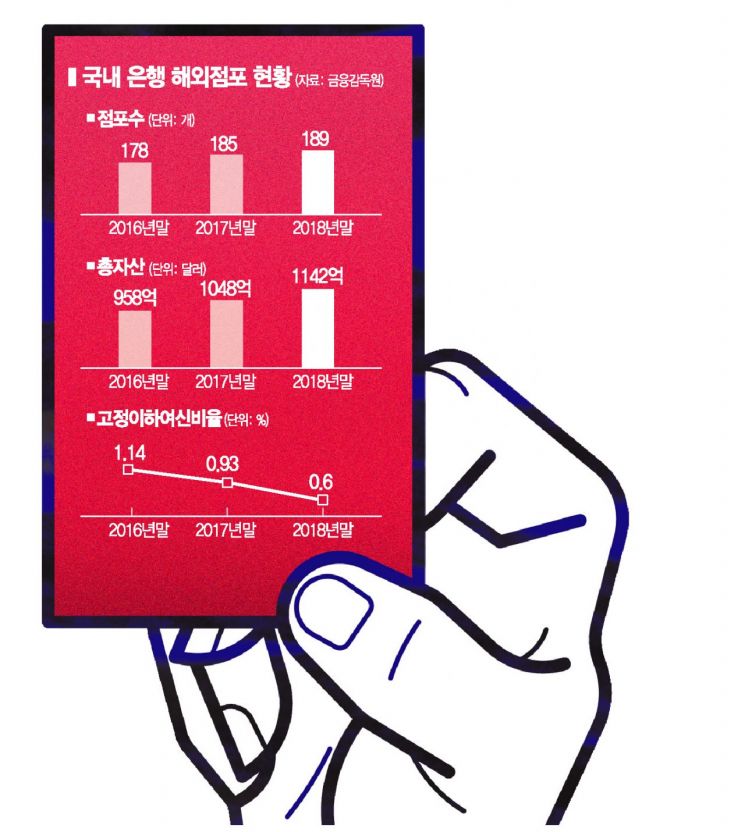
[Asia Economy Reporter Haeyoung Kwon] Financial authorities have ordered Woori Bank and KDB Industrial Bank to manage the soundness of their overseas assets. Amid ongoing global economic uncertainty raising concerns about the deterioration of overseas assets in the banking sector, they pointed out the credit quality of overseas subsidiaries' loan assets and foreign exchange risks, urging meticulous risk management.
According to the financial sector on the 21st, the Financial Supervisory Service (FSS) issued a management cautionary measure to Woori Bank’s local subsidiary in Russia following a management evaluation conducted in the second half of last year.
They criticized the aggressive credit policy that increased loan assets but also heightened concerns about potential defaults. Woori Bank’s Russian subsidiary’s loan receivables grew from 54.6 billion KRW at the end of 2018 to 84.5 billion KRW as of the third quarter of last year. Although the absolute scale is not large, the proportion of speculative-grade borrowers with credit ratings of 'BB+' or lower accounted for double digits among the total loan assets.
An FSS official said, "Woori Bank mainly operates with Hyundai Motor and its partners in Russia, and guarantees are provided at the headquarters level, but the high proportion of non-investment grade assets is problematic," adding, "We ordered the bank to strengthen internal procedures to perform credit supervision functions at the domestic level and to separate and secure the independence of the bad debt write-off review from the credit review department."
The FSS also conveyed concerns about capital soundness to KDB Industrial Bank’s local subsidiary in Uzbekistan. The Uzbek subsidiary is experiencing deteriorating profitability, asset decline, and a downward trend in the capital adequacy ratio, a key soundness indicator. The FSS demanded the establishment of management strategies to improve capital adequacy, including setting up a profit model, capital expansion, and stable funding structures.
They particularly pointed out the existence of foreign exchange risk due to the depreciation of the local currency, emphasizing the need for proactive measures. The FSS stated, "With the Uzbek government’s foreign exchange liberalization measures, increased reserve requirements, and the possibility of further hidden currency devaluation, there are concerns about continued deterioration of the business environment. Strategies to overcome adverse conditions and strengthen capital adequacy must be established."
The FSS conducts on-site inspections of some banks’ overseas subsidiaries annually. This time, it is noteworthy that they specifically targeted concerns about overseas loan asset deterioration and foreign exchange risks, which commercial banks are worried about amid the delayed global economic recovery. Although the US-China Phase One trade agreement has been finalized, avoiding the worst-case scenario, geopolitical risks from US-Iran conflicts and tariff disputes between the US and major trading partners remain. There are also concerns about a hard landing of the Chinese economy, which has entered a 6% annual growth era. For example, Hana Bank’s Chinese subsidiary’s net profit in the first half of last year was 14.436 billion KRW, down to one-third compared to 44.759 billion KRW a year earlier.
A representative from a commercial bank said, "The global economic recovery is slow and potential risks are increasing, so we are strengthening overall monitoring of overseas subsidiaries," adding, "Especially as overseas assets increase with expanded overseas expansion, we plan to focus on soundness management by carefully identifying default factors and foreign exchange risks."
© The Asia Business Daily(www.asiae.co.kr). All rights reserved.
![Clutching a Stolen Dior Bag, Saying "I Hate Being Poor but Real"... The Grotesque Con of a "Human Knockoff" [Slate]](https://cwcontent.asiae.co.kr/asiaresize/183/2026021902243444107_1771435474.jpg)
















