Concerns Over Trade Disputes Persist Despite US-China Phase One Trade Deal
Growth Base Worsens Due to Slowing Growth in Emerging Countries Like India
Stronger Policy Coordination and International Cooperation Urgently Needed
[Asia Economy New York=Correspondent Baek Jong-min] The International Monetary Fund (IMF) recently assessed that risk factors still persist in the global economy this year despite the Phase One trade agreement between the U.S. and China. Although U.S. President Donald Trump praised the recent trade deal and raised expectations for economic growth, the IMF's diagnosis indicates that the reality is otherwise.
Chief Economist Gita Gopinath emphasized on the 20th (local time) in Davos, Switzerland, during the release of the "World Economic Outlook" that risk factors remain. In an interview with CNBC and other outlets, she stated, "If trade tensions return, the recently reduced policy uncertainty will increase again," adding, "We need to watch carefully," expressing a cautious stance.
Chief Economist Gopinath said, "There are tentative signs of stabilization in global growth, but the economic outlook is sluggish and stronger multilateral cooperation is needed." She expressed concern, saying, "Despite the Phase One U.S.-China trade agreement, risks still exist. The possibility of a no-deal BREXIT is also significant."
On the same day, the IMF lowered its global economic growth forecast for this year to 3.3%, down 0.1 percentage points from the projection made three months ago. The IMF also revised next year's growth forecast down by 0.2 percentage points, from 3.6% to 3.4%.
The IMF cited the following as global economic risk factors: ▲ geopolitical tensions due to U.S.-Iran conflict ▲ tariff disputes between the U.S. and major trading partners ▲ disasters caused by climate change.
Chief Economist Gopinath particularly expressed concern about the possibility of additional trade disputes. She warned, "Trade conflicts between the U.S. and the European Union (EU) could escalate, and the truce between the U.S. and China could revert to a state of tension at any time."
This diagnosis suggests that if the recent trade tensions between the U.S. and Europe intensify, the stable atmosphere created by the Phase One U.S.-China trade agreement could quickly turn into a crisis. Given the numerous challenges such as intellectual property rights in the Phase Two U.S.-China trade agreement, optimism should be cautious.
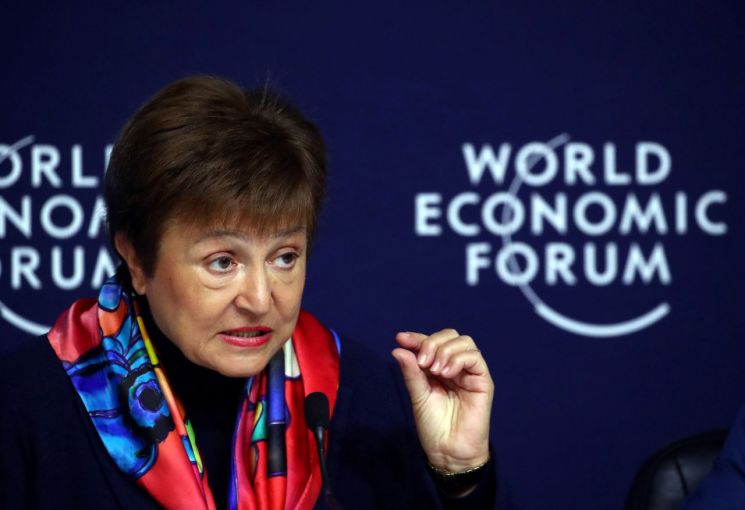
IMF Managing Director Kristalina Georgieva also stated at a press conference on the same day, "Global growth remains sluggish." She assessed, "The global economy's growth is still reliant on emerging markets, but their performance is below expectations, and advanced economies remain stuck in stagnation."
While China's growth is problematic, India's situation is also concerning. The IMF cut India's growth forecast for this year sharply from 7.0% to 5.8%, a 1.2 percentage point reduction. India's economic slowdown, which was expected to be a growth engine following China, is a negative factor for the global economy.
The IMF's emphasis on multilateral policy cooperation and proactive fiscal policies, warning that policy errors could further weaken the still fragile global economy, reflects this background.
© The Asia Business Daily(www.asiae.co.kr). All rights reserved.
![Clutching a Stolen Dior Bag, Saying "I Hate Being Poor but Real"... The Grotesque Con of a "Human Knockoff" [Slate]](https://cwcontent.asiae.co.kr/asiaresize/183/2026021902243444107_1771435474.jpg)











