"UN and US Sanctions on North Korea Not Related"
Separated Families' Visits to Geumgangsan and Kaesong
Discussion of Visiting North Korea via Third Countries
"North Korea's Personal Safety Guarantee is Essential"
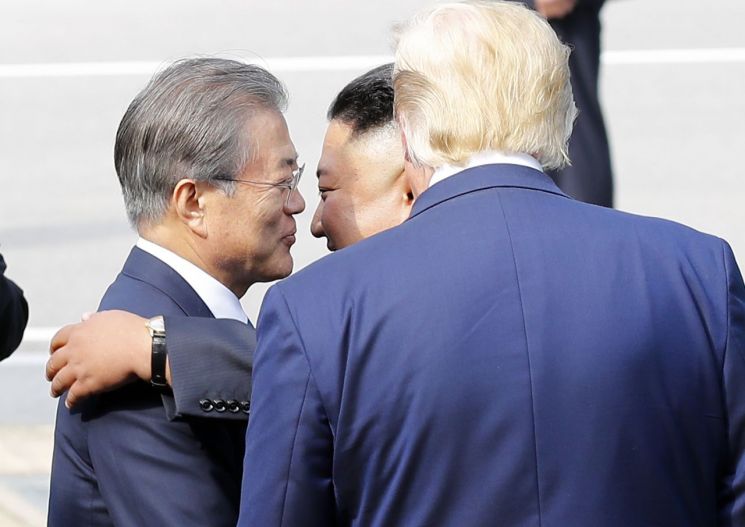 President Moon Jae-in is seen embracing Chairman Kim Jong-un, who is returning to the North, after meeting with U.S. President Donald Trump (right) at Panmunjom on the afternoon of June 30 last year.
 The government, which has declared a 'solo breakthrough' approach to inter-Korean relations, has reiterated its active intention to promote individual tourism to North Korea as a way to enhance inter-Korean exchange and cooperation under the North Korea sanctions.
On the 20th, the Ministry of Unification emphasized the necessity of individual tourism to North Korea through a 'Reference Material on Individual Tourism' and stated, "We are reviewing various measures, including how to proceed with consultations with the North."
The 'individual tourism' referred to by the government contrasts with the group tour method through existing cooperative business entities. The Ministry of Unification explained that it means traveling to North Korea individually after confirming the North's invitation through non-profit organizations or third-country travel agencies, rather than group tours through existing cooperative business entities, and obtaining travel approval.
Specifically, possible types include ▲ visits to the Mount Kumgang or Kaesong areas by separated families or social organizations ▲ visits to North Korean areas by South Koreans via third countries ▲ allowing foreigners to participate in inter-Korean linked tours.
The Ministry of Unification stated, "Individual tourism differs from the business-type Mount Kumgang tourism," and added, "Comprehensive personal safety guarantees between authorities are necessary when tourism fully resumes." Regarding documents guaranteeing personal safety, it explained, "Travel agencies work with the North to create these," and "As long as they comply with the government's principles on personal safety guarantees, there are no restrictions on the format of the documents."
The most realistic current plan for individual tourism to North Korea is as follows. If a travel agency called A negotiates with the North to create a North Korea tourism program for South Koreans, South Koreans wishing to visit North Korea can individually purchase the tourism products sold by that agency. Then, agency A collects the purchasers' personal information and contacts North Korean authorities to obtain documents expressing the North's willingness to accept them. These documents serve as the North's invitation and a pledge guaranteeing the invitees' personal safety. Agency A attaches these documents and sends them to the South Korean government, which screens for individuals subject to travel bans and grants final approval for travel to North Korea.
A Ministry of Unification official explained, "Which travel agency signs what travel program contract with the North and how the products are composed is created by the travel agency contacting the North, and the government performs the travel approval act." The official added, "In the approval process, we check whether minimum personal safety guarantees are included in our citizens' travel to the North, and if so, we approve it."
The Ministry of Unification emphasized that citizens from China, Japan, Australia, Canada, and European countries are already engaging in individual tourism to North Korea, stating, "There is no need to apply separate strict standards to our individual tourism, nor should we."
Regarding concerns that individual tourism might undermine South Korea-US cooperation or create loopholes in the international sanctions regime against North Korea, the ministry strongly refuted such claims. It stated, "The government will continue efforts to substantially advance inter-Korean relations through individual tourism and other means, thereby facilitating the prompt resumption of North Korea-US dialogue."
The Ministry of Unification clarified, "Individual tourism is not subject to UN sanctions and is a project we can independently pursue," adding, "It is also not subject to 'secondary boycott'." The 'secondary boycott' refers to the US's unilateral sanctions targeting third-country companies and individuals involved with North Korea.
Furthermore, it emphasized, "The US respects decisions made by us as a sovereign nation and cooperates closely through various channels."
Regarding expenses incurred by travelers in North Korea, the ministry interpreted them as "local actual expenses such as accommodation and meals," and stated that these are unlikely to be considered 'bulk cash' transfers restricted by sanctions.
However, it remains uncertain how much the North will respond to these government efforts. The Ministry of Unification said, "The North has not yet shown any official response to individual tourism."
The North's indication of willingness to develop its tourism industry through new tourist complex construction and improved operational procedures (such as expedited visa issuance) could be a variable. Last year, North Korean State Affairs Commission Chairman Kim Jong-un ordered the dismantling of South Korean facilities in Mount Kumgang but also stated, "We will always welcome South Korean compatriots if they come."
© The Asia Business Daily(www.asiae.co.kr). All rights reserved.
![Clutching a Stolen Dior Bag, Saying "I Hate Being Poor but Real"... The Grotesque Con of a "Human Knockoff" [Slate]](https://cwcontent.asiae.co.kr/asiaresize/183/2026021902243444107_1771435474.jpg)
















