[Asia Economy Reporter Kim Hyo-jin] From the 20th, the path to jeonse loans for owners of high-priced homes valued over 900 million KRW will be virtually completely blocked. This is because private SGI Seoul Guarantee Insurance (SGI), like public guarantee institutions such as the Korea Housing Finance Corporation (KHFC) and the Housing and Urban Guarantee Corporation (HUG), will prohibit guarantees for jeonse loans to owners of high-priced homes.
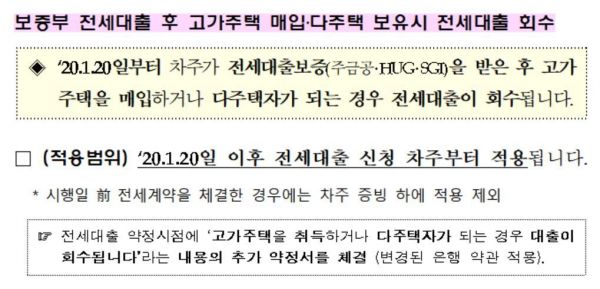
If a borrower obtains a jeonse loan guarantee from these institutions and then purchases a high-priced home or becomes a multi-homeowner, the jeonse loan will be recalled in almost all cases without exception. The Financial Services Commission announced on the 16th the follow-up measures related to jeonse loans under the '12.16 Housing Market Stabilization Plan,' which will be implemented from today. The aim is to more strictly block 'gap investment,' where people buy houses using jeonse deposits for speculative purposes.
The restriction on jeonse loan guarantees for owners of homes valued over 900 million KRW under public guarantees has been in effect since November 11 of last year, following measures announced in October. This new measure expands the guarantee restrictions to the private sector utilizing private funds.
High-priced home owners currently using SGI jeonse loan guarantees before the 20th will be allowed to extend their guarantees upon maturity, but if moving to a new jeonse residence or increasing the jeonse loan amount is involved, it will be considered a new loan guarantee, and in principle, extension at maturity will not be allowed.
However, to prevent sudden housing instability due to the suspension of jeonse loans, the financial authorities have allowed, on a temporary basis until April 20, one-time use of SGI guarantees for high-priced single-home owners with homes valued between 900 million KRW and 1.5 billion KRW who reuse loans without increasing the amount when moving to a new jeonse residence as of today.
For owners of ultra-high-priced homes valued over 1.5 billion KRW, this temporary grace period will not apply, and regulations will be fully enforced. Exceptions are recognized for cases of actual demand such as job transfers, career changes, children's education, medical treatment, or parental care that require living in a jeonse residence outside the city or county where the owned home is located. Even in such cases, household members must reside in both the jeonse residence and the owned high-priced home.
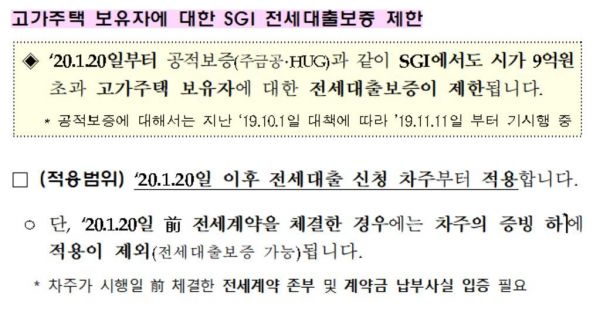
The jeonse loan recall regulation applies to borrowers who apply for jeonse loans after today. The financial authorities have required banks to amend their terms and conditions to include an additional agreement stating, "If you acquire a high-priced home or become a multi-homeowner, the loan will be recalled" at the time of jeonse loan contracting.
Borrowers currently using jeonse loan guarantees before the 20th who acquire high-priced homes or become multi-homeowners after the 20th are not subject to immediate loan recall but will face restrictions on loan extension at maturity. However, in cases of acquiring high-priced homes or transitioning to multi-homeownership through inheritance, recall will be deferred until the maturity of the relevant jeonse loan.
The financial authorities will form a joint inspection team with guarantee institutions to visit branches of major banks and check the application of regulations. They also plan to prevent evasion or circumvention of jeonse loan guarantee restrictions through individual guidance to banks and others.
At the same time, they will inspect the status of unsecured jeonse loans by financial company to ensure that loans do not increase after the regulation is implemented. If necessary, they will analyze detailed transaction data and, if it is judged that these are being used to evade jeonse loan regulations, additional measures such as restricting public guarantee supply to the relevant financial companies will be taken.
A Financial Services Commission official said, "We have no choice but to strictly respond to gap investments using jeonse loans that cause instability in the housing market," adding, "We will closely monitor future developments and consider additional measures if necessary."
© The Asia Business Daily(www.asiae.co.kr). All rights reserved.



















