January 7 to March 20: 400 Public Officials and Tongjangs Deployed to Conduct Fact-Finding on Residents' Actual Occupancy... Counseling and Support Procedures Followed Upon Identifying Vulnerable Households
[Asia Economy Reporter Jongil Park] Yongsan-gu (Mayor Seongjanghyun) is focusing administrative efforts on identifying vulnerable households in welfare blind spots in connection with the 2020 Resident Registration Fact-Finding Survey (1.7.~3.20.).
The Resident Registration Fact-Finding Survey is a procedure to verify resident registration details and actual residence according to Article 20 of the Resident Registration Act. It investigates unreported changes of residence, false registrations, and checks the survival status of suspected deceased persons. It also conducts surveys on long-term absentees and school-age children not attending school.
The investigators (joint investigation team) consist of 400 people, including officials from 16 community service centers (our neighborhood officers) and neighborhood leaders (welfare neighborhood leaders). They visit every household in the area to confirm residents' presence.
In particular, the district organizes the resident registration list as "residence unknown" after going through the highest notice and announcement procedures for residents who are registered but whose residence cannot be confirmed. If false or duplicate reports are clear, legal action can also be taken.
When resident registration is canceled or marked as residence unknown, the resident must pay a fine to the district during the re-registration process. However, if previously canceled persons voluntarily report during the fact-finding period, the fine can be reduced by up to three-quarters.
Following Seoul city guidelines, the district is conducting the resident registration fact-finding survey and welfare blind spot identification simultaneously this year. When vulnerable or crisis households needing help are found on site, they are guided to fill out a counseling application form, which is then forwarded to the social workers (welfare planners) at the community service centers. Afterwards, the welfare planners visit the site for secondary counseling.
A district official said, “We plan to focus on households where the head of household has lost their job or cannot work due to an accident, households with power or water cut off, and households with tax arrears. If identified as crisis households, support will be provided through public benefits, private resource services linkage, and case management.”
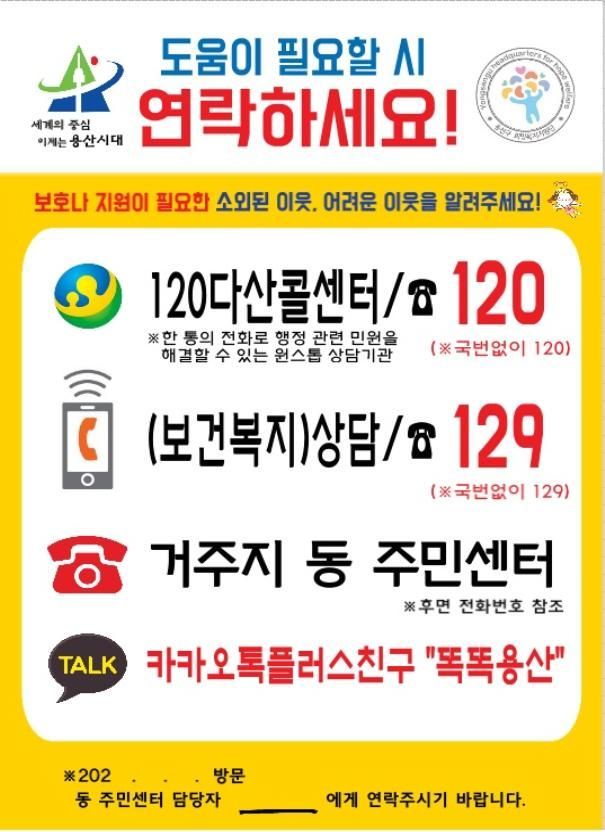
The district also created a “Welfare Counseling Guide Sticker” to distribute to vulnerable households during field visits. It includes contact information for the 120 Dasan Call Center, Health and Welfare Counseling Call Center (129), and the relevant community service center, allowing residents to request counseling directly if needed.
Seongjanghyun, Mayor of Yongsan-gu, said, “This year, for the first time, we are conducting the resident registration fact-finding survey and welfare blind spot identification simultaneously. The district will do its best in field investigations to ensure that no citizen is left behind.”
Autonomous Administration Division (☎2199-6373), Welfare Policy Division (☎2199-7062)
© The Asia Business Daily(www.asiae.co.kr). All rights reserved.
![Clutching a Stolen Dior Bag, Saying "I Hate Being Poor but Real"... The Grotesque Con of a "Human Knockoff" [Slate]](https://cwcontent.asiae.co.kr/asiaresize/183/2026021902243444107_1771435474.jpg)
















