Im Seong-cheol, Head of the Gangnam District Branch of the Integrated Public Officials Union, Expresses Commitment to Raising Multi-Faceted Evaluation from Bottom 5% to 15%, Increasing Wages for Part-Time Fixed-Term Public Officials, and Implementing Employee Safety Measures Such as Hanging Taegeukgi Flags on Main Roads in the '2020 Integrated Labor Union Gangnam District Branch Activity Goals'
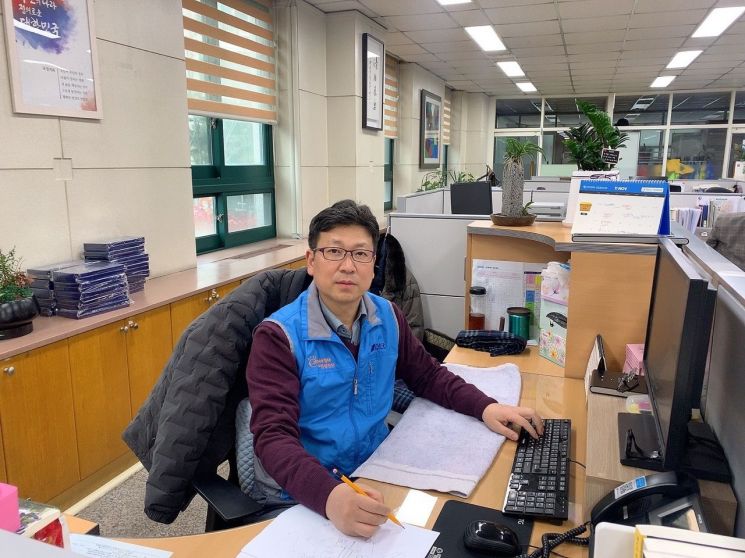
[Asia Economy Reporter Jong-il Park] "We plan to propose raising the bottom 5% to 15% in the multi-faceted evaluation results."
This was stated by Seongcheol Lim, head of the Gangnam branch of the Integrated Public Officials Union, in a post titled "2020 Activity Goals of the Integrated Labor Union Gangnam Branch."
Lim said, "In the second half of last year and the first half of this year, the ‘Promotion Review Committee’ reflected the multi-faceted evaluation results and excluded low scorers from the 1.5 times promotion candidates. The foundation of a personnel culture where employees who harm organizational harmony and unity and rely on personal connections can no longer be promoted has now been laid," he said.
However, considering that there are always at least 2 to 3 underqualified employees at the relevant rank, he said he plans to propose reflecting about 15%.
He explained that since there are people who can evade like loaches, it is necessary to raise the ratio to minimize employee damage.
He also mentioned that despite the organizational diagnosis of Gangnam District Office, effective work coordination between departments still seems insufficient, citing examples such as the hourly wage adjustment for temporary grade Ma employees discovered through union member reports last year.
Lim said, "On June 19 last year, through a meeting with the district mayor, we proposed improving the wage payment method and raising wages for our district’s hourly temporary (grade Ma) employees. The General Affairs Division finalized the budget planning through consultation with the Finance Division, and the General Affairs Division’s HR team oversees the overall management while the Finance Division’s expenditure team handles wage payments."
He claimed that until now, unlike other districts, Gangnam District Office mobilized 78 people across 33 departments to pay wages to hourly temporary employees, and due to wage freezes for eight years, a gap of more than 400,000 won compared to other districts had developed, causing dissatisfaction among department staff. However, the office had failed to properly grasp the inefficient organizational operation method.
Although the 2020 adjusted wages are implemented based on the current Grade 9, Step 1 standard, the amount is still below the 1,424,752 won livelihood benefit for a four-person household. Since wages had never been raised before, it may appear as a wage increase, but in reality, it only barely matches the average level of other districts.
Lim said, "This year, we plan to make efforts to ensure a realistic wage increase that properly reflects the workload of Gangnam District Office."
He also pointed out that sometimes, even when it is not a specialized field, situations arise where buildings, welfare centers, or housing need to be constructed. It is efficient for the specialized Architecture Department to handle construction, while the relevant departments manage operation and maintenance. Parking violations, even in disabled parking zones, should be uniformly handled by the Parking Management Division without legal disputes, and road surface markings and accessory installations for traffic facilities should be managed by the Road Management Division to prevent duplicate budget expenditures and save costs.
He expressed frustration that every year, progress is stalled due to misunderstandings and conflicts between departments, and that excuses such as insufficient staff according to internal regulations or dismissing tasks as ongoing regardless of job nature are regrettable.
Lim said, "If workload is analyzed and specialized or temporary employees are separately hired and managed, there would be no interdepartmental conflicts and less burden on employees."
He also revealed plans to promote outsourcing for the installation of street flags such as the national flag and civil defense flags along main roads at the district office level, so that employees at each community service center can avoid safety accidents.
Employees are heavily exposed to risks whenever they perform these tasks using community patrol vehicles, so outsourcing is necessary and can also create jobs.
He also plans to propose institutional improvements to build a computerized system that allows simultaneous monitoring of each department’s response methods and situations at community service centers during various disasters and emergencies.
He argued that if the disaster headquarters’ situation room during natural disasters like Typhoon Lingling were set up not in the district office annex but in the Disaster Safety Division’s Urban Control Center, it would be possible to monitor and control emergency situations anytime and anywhere. Connecting multipurpose CCTVs would alleviate the frustration of learning about disasters only after the fact, and he has proposed the use of multipurpose CCTVs to the district’s Disaster Safety Division Urban Control Team.
The department responded that it is not possible citing the ‘Personal Information Protection Act,’ but Lim emphasized that in today’s information age, this seems like a case of passive administration and welfare inertia, and he intends to push for it again.
© The Asia Business Daily(www.asiae.co.kr). All rights reserved.
![User Who Sold Erroneously Deposited Bitcoins to Repay Debt and Fund Entertainment... What Did the Supreme Court Decide in 2021? [Legal Issue Check]](https://cwcontent.asiae.co.kr/asiaresize/183/2026020910431234020_1770601391.png)
















