[Asia Economy Reporter Kim Heung-soon] Netflix, the world's largest online video service (OTT), plans to invest over 20 trillion won this year alone to further strengthen its content. This move is interpreted as a response to competing OTT platforms such as Disney and Apple. In South Korea, where up to 1,500 Netflix contents are introduced annually, competition among OTT providers is expected to become much fiercer.
Global market research firm BMO Capital analyzed on the 17th (local time) that Netflix will invest $17.3 billion (approximately 20.5 trillion won) in content this year and will continue to increase its investment annually, estimating an investment of $26.3 billion (30.48 trillion won) by 2028. This is also seen as a measure to gain an advantage amid the growing number of streaming competitors such as Apple TV Plus, Disney Plus, WarnerMedia's HBO Max, and Comcast's Peacock.
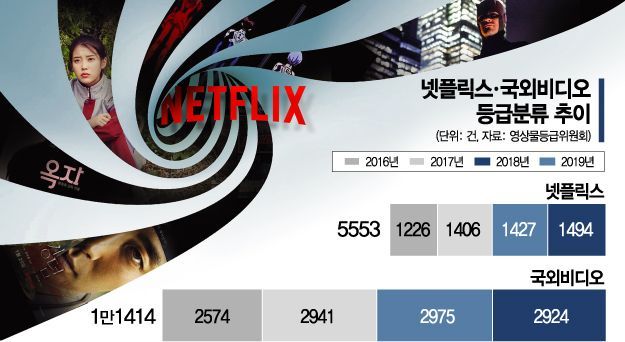
◆ Growing 'Content Giant' = Netflix is the number one global OTT provider operating in over 190 countries worldwide. As of the third quarter of last year, it had 160 million paid subscribers. It is known that 140 million hours of content are consumed daily. With this massive volume of content, Netflix quickly dominated the global market. South Korea is no exception. Analyzing the recent four years of data from the Korea Media Rating Board, which reviews and classifies films, videos, performances, advertisements, and promotional materials, Netflix requested classification for a total of 5,553 foreign videos. Classification is a mandatory procedure that domestic and foreign video content must undergo before distribution in South Korea.
In 2016, the year Netflix entered the Korean market, 1,226 foreign videos were classified. An industry insider said, "When a cable channel launches, it typically secures around 130 pieces of content." Based on this, Netflix provided about 10 times more content than existing video platforms when it started service in Korea. The number of classified foreign videos increased by nearly 200 to 1,406 the following year, then steadily rose to 1,427 in 2018 and 1,494 in 2019. During the same period, Netflix content accounted for 48.7% of all classified foreign videos (11,414 cases). As Netflix invests over 20 trillion won to strengthen content this year, its status as a 'content giant' worldwide is expected to grow even further.
◆ Government to Support Domestic OTTs... = Amid this trend, the Korean OTT market is poised for significant changes. Disney Plus and Apple TV Plus, considered rivals to Netflix, are expected to launch services in South Korea as early as this year. With platforms like Netflix and YouTube already well-established, the entry of additional providers is expected to drive rapid growth in the OTT market. According to the Ministry of Science and ICT, the global OTT market size grew from 17 trillion won in 2014 to 46 trillion won in 2018 and is projected to nearly double to 86 trillion won by 2023.
The Korean government plans to ease regulations and increase support to ensure domestic OTT companies do not fall behind in competition with Netflix, YouTube, and others. According to the New Year work plans of the Ministry of Science and ICT and the Korea Communications Commission, 3.7 billion won will be allocated this year to activate the production of OTT-specialized content such as web dramas, web entertainment, short-form (short, complete videos), and one-person media. Additionally, 4.2 billion won will be invested to establish OTT training courses for professionals in the broadcasting content field and to expand the number of courses offered (from 135 to 145).
Illegal activities by overseas operators will also be strictly investigated and monitored, and major foreign operators will be included in user protection evaluations to ensure regulatory fairness between domestic and international providers. To this end, a cross-government task force (TF) comprising the Office for Government Policy Coordination, Ministry of Science and ICT, Ministry of Economy and Finance, Korea Communications Commission, Financial Services Commission, Ministry of Employment and Labor, Ministry of Culture, Sports and Tourism, and Fair Trade Commission will be formed. They plan to establish a plan for creating a virtuous cycle ecosystem of content, platforms, and networks (tentatively named the Digital Media Ecosystem Development Plan) by March.
© The Asia Business Daily(www.asiae.co.kr). All rights reserved.


















