EU Commission Considers Single Standard for Charging Methods
The Verge: "Wrong to Assume Lightning Port Will Disappear Due to EU Measures"
"Apple Already Provides USB-C Chargers for iPhone 11 Pro and Others"
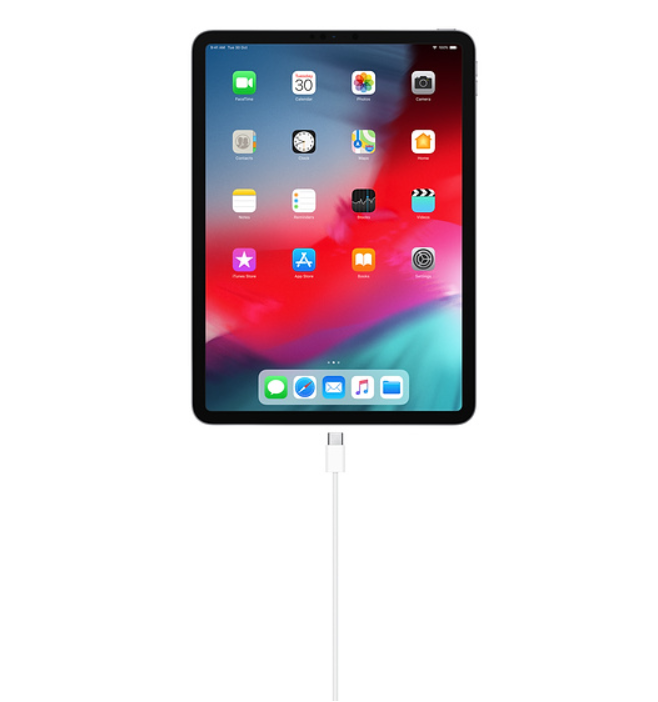
[Asia Economy Reporter Han Jinju] The speculation that the iPhone's Lightning charging port might disappear due to the European Union (EU) adopting a single universal charging standard has been pointed out as a misunderstanding. Apple already produces USB-C type charging ports, and the EU has not specifically mentioned Apple's Lightning charging port.
On the 17th (local time), IT specialist media The Verge stated, "The belief that Apple's Lightning port and cable will disappear all at once due to the EU's measures is a mistaken certainty," adding, "The EU's review does not concern smartphone cables or connector ports, nor does it propose changes to the Lightning port."
The Verge explained, "Even if all chargers worldwide switch to USB-C, Apple will not remove the Lightning port from its smartphones. Apple already manufactures and ships USB-C chargers," adding, "The iPhone 11 Pro and iPhone 11 Pro Max include an 18W USB-C charger and a Lightning to USB-C cable, and the iPad Pro and MacBook released in 2018 use USB-C chargers and cables."
Earlier, according to the BBC and others, on the 13th (local time), the EU Commission was reviewing a proposal to mandate a single standard for smartphone charging ports, as urged by EU Parliament members. Foreign media analyzed that if this proposal passes, Apple might have to replace the Lightning connector port with the standardized charging port. The Verge's analysis is that the EU Commission's review concerns the 'charging method,' not charging cables or connector ports.
Currently, the most commonly used charging ports are the Lightning connector applied to iPhones, the micro USB used in older Android phones, and USB-C used in recently released Android devices. Android devices occupy more than 80% of the global smartphone market, and most smartphones use USB-C charging ports. Apple attempted changes by providing USB-C cables and chargers with the iPhone 11 Pro and 11 Pro Max released last year. Apple has applied the 'Lightning connector' to iPhones and iPads since 2012.
Vice President Maros Sefcovic pointed out that smartphone manufacturers have adopted more than 30 different charging methods so far. This has resulted in about 51,000 tons of discarded old chargers annually. In 2014, the EU Parliament passed a wireless equipment directive demanding efforts to develop a 'universal charger' related to standard charging ports. However, this directive was not mandatory. Apple did not accept it, citing that devices are becoming thinner and that applying USB-C type charging ports would cost over 2 trillion won.
The Verge explained, "Since Apple is one of the major smartphone manufacturers, Apple's old chargers may account for a significant portion of waste, but the European Commission did not mention Apple," adding, "Even if Apple is forced to include USB-C type charging adapters in iPhone boxes, it would not be a difficult task."
However, there have been ongoing predictions that charging ports will eventually disappear completely, similar to the 3.5mm earphone jack. Apple specialist analyst Ming-Chi Kuo forecasted in a report that Apple might exclude the Lightning connector from the highest-end iPhone model released in 2021. The British investment bank Barclays also analyzed that "Apple is likely to remove the Lightning connector from at least one iPhone model next year." If the Lightning cable disappears, charging and data transfer will be wireless, and wired earphones previously bundled may also disappear.
© The Asia Business Daily(www.asiae.co.kr). All rights reserved.

![Clutching a Stolen Dior Bag, Saying "I Hate Being Poor but Real"... The Grotesque Con of a "Human Knockoff" [Slate]](https://cwcontent.asiae.co.kr/asiaresize/183/2026021902243444107_1771435474.jpg)














