'Hateful Expressions' Like 'Seolmyeongchung' and 'Matchumbeopchung' Flood
5 out of 10 Office Workers Dislike 'OOchung'
"Related to 'Group Division'"
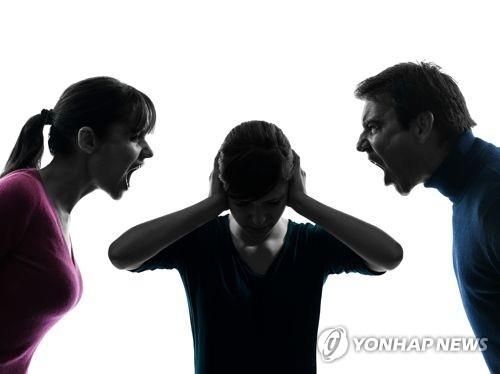
[Asia Economy Reporter Heo Midam] # Kim Mo (34) recently went to a restaurant alone with her 4-year-old daughter and was called a 'mamchung.' Kim said, "I did nothing wrong at the restaurant, but I was called 'mamchung' just because I brought my child," adding, "I'm worried that my child might have heard it." She lamented, "Wherever I go with my child, I hear 'mamchung.' I'm afraid to go out with my child."
Recently, conflicts have arisen due to 'hate speech' (discriminatory and hateful remarks against specific groups), which involves attaching the character 'chung' (蟲, meaning insect) to certain groups of people to express hatred.
Such hateful expressions are commonly encountered not only online, where anonymity is guaranteed, but also in everyday life, making it a serious social problem. Experts analyze that this phenomenon is related to division and polarization.
Six out of ten citizens have encountered hateful expressions. According to the '2019 Hate Discrimination Public Awareness Survey Report' conducted by the National Human Rights Commission in November last year, surveying 1,200 adult men and women nationwide, 64% of the public had encountered hateful expressions online or offline in the past year.
Regarding the frequency of experiences by target group, 74% of respondents experienced hateful expressions against people from specific regions such as Jeolla-do or Gyeongsang-do. This was followed by feminists (69%), women (68%), elderly people (67%), sexual minorities (67%), immigrants (66%), men (59%), and people with disabilities (58%).
University student A (25) also recently heard hateful expressions. He said, "I once pointed out a friend's spelling mistake while chatting on messenger. At that time, my friend said, 'Aren't you a spelling-chung?'" He raised his voice, saying, "I was just correcting something wrong, but being called 'spelling-chung' was ridiculous."
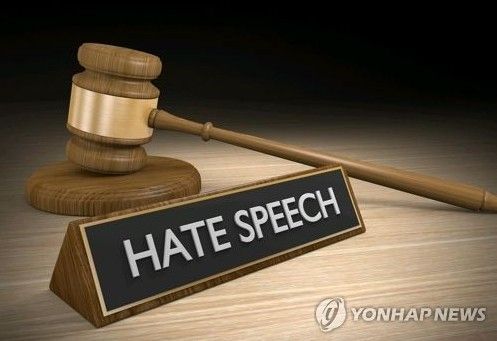
The suffix 'chung' (insect), which was used as a derogatory or belittling expression, has gradually been used as a slang term referring to specific groups of people. Following the term 'Ilbe-chung' used for far-right Ilbe users, terms like 'Jinjichung' (a person who is serious about everything) and 'Seolmyeongchung' (a person who explains excessively at length) are examples.
Hateful expressions have been actively used on the internet, where anonymity is guaranteed, but recently they have been used without hesitation in everyday life, which is problematic.
University student B (23) said, "Not long ago, while sharing worries about the future with a friend, I was called 'jinjichung.' I was already overwhelmed by worries about the future, so hearing 'jinjichung' suddenly was not only absurd but also made me angry," she lamented.
As a result, more people are expressing discomfort with hateful expressions. According to a survey conducted by the job portal JobKorea in 2017 targeting 854 office workers about the usage of new slang, 59.7% of respondents said there are new slang terms they find unpleasant, and among them, 56.5% pointed to terms ending with 'OO-chung.'
Some people said they used such words because they were swept up by the atmosphere. Office worker C (25) explained, "Since people around me use them, I also often use them. For example, when seeing people smoking on the street, others disparagingly call them 'gilppang-chung' (street smoking insect), so I also used the term 'gilppang-chung' without any sense of problem."
Experts analyze that hateful expressions are related to the phenomenon of unconditionally blaming other groups.
Professor Kwak Geumju of the Department of Psychology at Seoul National University pointed out, "The biggest problem in our society is group conflict," emphasizing, "People unconditionally criticize those who think differently from themselves. In other words, they engage in 'group division.'"
She continued, "When people feel their own group is superior, they can relieve their stress. To evaluate their own group more positively, they have to belittle other groups. As a result, hateful expressions are increasing."
© The Asia Business Daily(www.asiae.co.kr). All rights reserved.
![Clutching a Stolen Dior Bag, Saying "I Hate Being Poor but Real"... The Grotesque Con of a "Human Knockoff" [Slate]](https://cwcontent.asiae.co.kr/asiaresize/183/2026021902243444107_1771435474.jpg)

















