Bankers' 'Retirement Clock' Speeds Up
'Cheolbapttong' Like Civil Servants Is a Thing of the Past
No Labor-Management Conflicts Unlike Before
Applications Flood for Special Retirement Bonuses Worth Hundreds of Millions
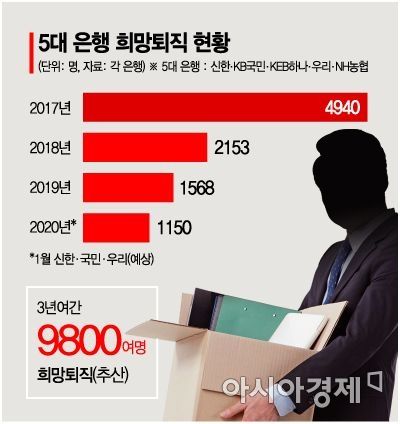
[Asia Economy Reporter Kim Min-young] It has been revealed that approximately 10,000 bank employees from the five major banks have taken early retirement through voluntary retirement programs over the past three years. This trend is attributed to the introduction of the wage peak system accelerating the 'retirement clock,' coupled with a growing sentiment of 'let's leave while we can' as employees secure retirement bonuses worth hundreds of millions of won. The government's job creation policies have also contributed to the activation of voluntary retirement. Some critics point out that in a situation where branch offices are shrinking, a vicious cycle is repeating where resources are shifted from one area to support another, such as expanding new hires by cutting elsewhere.
According to the financial sector on the 17th, the total number of employees who left through voluntary retirement from the five major banks?Shinhan, KB Kookmin, KEB Hana, Woori, and NH Nonghyup?between 2017 and the end of last year was 8,661.
Nearly 2,000 bankers left or are scheduled to leave the banks at the end of last year and early this year. At the end of last year, 369 and 356 employees left Hana Bank and Nonghyup Bank, respectively, through voluntary retirement.
KB Kookmin Bank confirmed the voluntary retirement scale at around 460 employees on the same day. Shinhan Bank will finalize the number of voluntary retirees by the end of this month. Last year, 230 employees left. Woori Bank plans to release about 300 employees by the end of this month.
Combining the voluntary retirees over the past three years and those scheduled for early retirement this year, the total is estimated to be up to approximately 9,760 employees. This figure excludes natural attrition such as regular retirements.
A notable feature of recent voluntary retirements in the banking sector is that they have proceeded without major conflicts between labor and management. In the past, large-scale restructuring faced strong opposition from labor unions, but now, with substantial benefits such as special retirement bonuses, reemployment opportunities, and children's tuition support, applications from employees have surged.
KB Kookmin Bank, which released 2,795 employees in 2017, is a representative case. At that time, large-scale voluntary retirement was conducted regardless of tenure for the 'L0' group, which had been converted from non-regular to regular employees, and it was completed without issues.
In the same year, Woori Bank also accepted its first voluntary retirement since privatization, releasing 1,011 employees without controversy. It is said that applications surged after increasing special retirement bonuses to levels comparable to other commercial banks (30 to 36 months of base salary).
Since then, the payment of special retirement bonuses and various benefits to voluntary retirees has become a standard practice in the banking sector. At the end of last year, Hana Bank, which conducted voluntary retirement, paid 277 employees born in 1964 and 1965 an average of 22 and 31 months' wages, respectively, along with children's tuition support (up to 20 million won per person), medical expenses (up to 20 million won), and 20 million won for reemployment and career transition support.
Ninety-two general employees aged 40 or older with more than 15 years of service were treated as 'quasi-retirement,' receiving up to 27 months' average wages, children's tuition, and medical expenses.
NH Nonghyup Bank's special retirement targets are employees born in 1963 or those aged 40 or older with more than 10 years of service. Nonghyup paid these employees special retirement bonuses equivalent to 20 to 28 months of average wages.
Woori Bank, where about 300 employees born in 1964 and 1965 are expected to take voluntary retirement, plans to provide special retirement bonuses equivalent to 30 months and 36 months of average wages, respectively.
KB Kookmin and Shinhan Banks offer similar benefits. A source from a commercial bank hinted, "There is a sentiment among bankers that rather than being promoted to branch manager or department head?the 'prime' positions?they prefer to take special retirement bonuses worth hundreds of millions of won and prepare for a 'second act' in life."
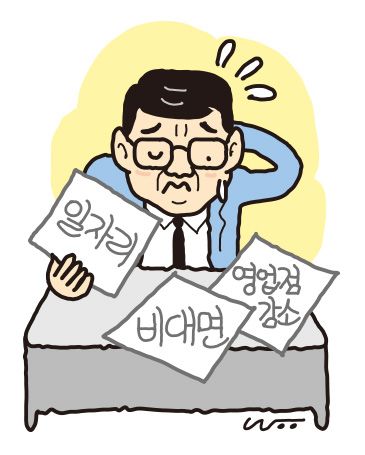
From the banks' perspective, this helps resolve the inverted pyramid structure and creates capacity to hire many young employees for digitalization. With the activation of digital finance such as internet and mobile banking, non-face-to-face transactions are increasing, and branch numbers are decreasing, maintaining a high need for workforce reduction. The number of branches of the five major banks decreased by 46 from 4,332 at the end of September 2018 to 4,286 at the end of September last year.
The government's job creation policies are also one of the factors increasing voluntary retirement. The government has continuously exerted implicit pressure on banks to release older employees and increase youth employment. In response, the banking sector has conducted large-scale recruitment annually. The five major banks hired 2,437 new employees in 2017, 3,408 in 2018, and 4,190 last year.
Some critics argue that hiring new employees equivalent to the number of voluntary retirees is a case of 'taking a stone from the top to support the bottom.' Bank management needs to strategize within the broader framework of workforce restructuring due to economic downturns and declining profitability in the banking industry, but a vicious cycle repeats where the parent generation is released and the child generation is employed on a larger scale.
In fact, the number of bank employees has not changed significantly. The number of employees at the five major banks decreased by only 606, from 69,199 at the end of September 2018 to 68,593 at the end of September last year.
© The Asia Business Daily(www.asiae.co.kr). All rights reserved.
![Clutching a Stolen Dior Bag, Saying "I Hate Being Poor but Real"... The Grotesque Con of a "Human Knockoff" [Slate]](https://cwcontent.asiae.co.kr/asiaresize/183/2026021902243444107_1771435474.jpg)


















