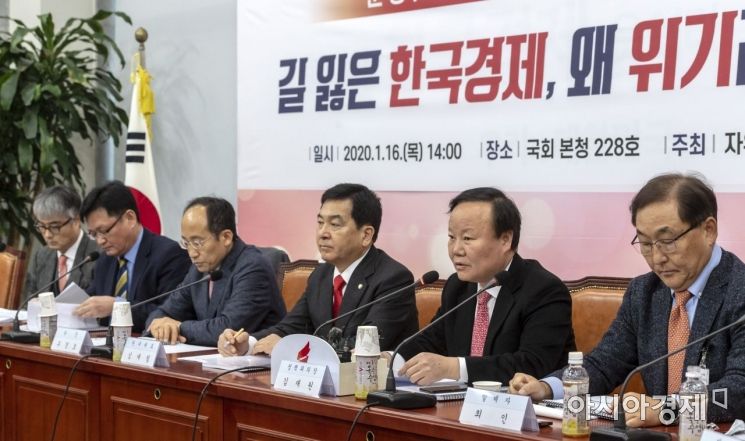
 Sim Jae-cheol, floor leader of the Liberty Korea Party, is speaking at the "Moon Administration Economic Policy Evaluation and Livelihood Economy Crisis Diagnosis Meeting" held at the National Assembly on the 16th. Photo by Yoon Dong-joo doso7@
[Asia Economy Reporter Park Cheol-eung] The Liberty Korea Party has announced a 'New New Town' pledge. It also proposed measures to ease loan regulations, effectively encouraging people to 'buy houses with borrowed money.' This revives the 'New Town' policy, which was a major factor in the ruling Hannara Party's victory in the 2008 general election, as well as the real estate policies of the Park Geun-hye administration.
The Seoul branch of the Liberty Korea Party announced its first general election pledge, the 'Seoul-type Housing Policy,' on the 16th. The head of the Seoul branch is Representative Na Kyung-won.
The 'New New Town' plan aims to increase project feasibility through high-density development such as floor area ratio expansion and to enlarge the district area to a scale between horizontal housing maintenance projects and New Town projects. Unlike existing small-scale redevelopment and reconstruction, it combines floor area ratio incentives with securing public facilities.
The Seoul branch stated, "Since Mayor Park Won-soon's inauguration, New Town projects have been labeled as corrupt practices, and large-scale maintenance project areas have been canceled despite the sunk costs invested with citizens' taxes. Naturally, the Seoul housing market is in great confusion due to supply-demand mismatches."
In the 2008 general election, the then Hannara Party won a landslide victory by pledging New Town projects, securing 40 out of 48 seats in Seoul. However, the projects in designated New Town areas were not properly implemented, increasing sunk costs and causing significant difficulties as an 'exit strategy.' Terms like 'New Town backlash' and 'New Town curse' circulated widely.
The Seoul branch also announced plans to actively consider significantly easing or consolidating the sub-classifications of general residential areas to introduce deregulation that promotes high-density development and public facility maintenance simultaneously. Seoul City has restricted floor area ratios by subdividing general residential areas into types 1 to 3 since 2003 to prevent high-density indiscriminate development. However, most hilly areas such as Gangbuk are regulated as types 1 and 2, which is seen as a major constraint on improving poor-quality housing.
Meanwhile, the Liberty Korea Party proposed easing mortgage loan standards as a central party housing pledge. The plan is to relax loan regulations for first-time homebuyers and temporary owners of two houses for actual residence purposes. This recalls the so-called 'Choi-nomics' and loan deregulation policies during the tenure of former Deputy Prime Minister and Minister of Strategy and Finance Choi Kyung-hwan under the Park Geun-hye administration.
This is in stark contrast to the Moon Jae-in administration's real estate policies. On the 14th, President Moon said at a press conference, "The goal is not simply to prevent further price increases," adding, "In some areas, there have been such rapid price increases that ordinary citizens find them hard to accept and feel alienated by; these must be restored to their original state."
Park Kwang-on, a Supreme Council member of the Democratic Party, criticized on the 17th at an expanded executive meeting, "The Liberty Korea Party reversed its first pledge and even presented a 'pro-Park' pledge," adding, "During former President Park Geun-hye's administration, the increase rate of single-homeowners was 1.1%, but when policies encouraging buying houses with debt were implemented, the number of owners with three or more houses increased by a staggering 22%."
He continued, "During the same period, 40% of new real estate rental business operators were under 30 years old," and said, "A very small number of speculative forces disrupt the market and gain unearned income, which disturbs the market economy. The Liberty Korea Party claims to remove the 'tax bomb,' but Korea's property tax as a percentage of GDP is 0.8%, lower than the OECD average. It is less than one-third of the levels in the US and the UK. Calling it a 'tax bomb' is a distortion aimed at undermining government housing policies."
© The Asia Business Daily(www.asiae.co.kr). All rights reserved.
![Clutching a Stolen Dior Bag, Saying "I Hate Being Poor but Real"... The Grotesque Con of a "Human Knockoff" [Slate]](https://cwcontent.asiae.co.kr/asiaresize/183/2026021902243444107_1771435474.jpg)
















