Monetary Policy Direction Decision Meeting of the Bank of Korea on the 17th
Export and Facility Investment Slump Expected to Gradually Ease
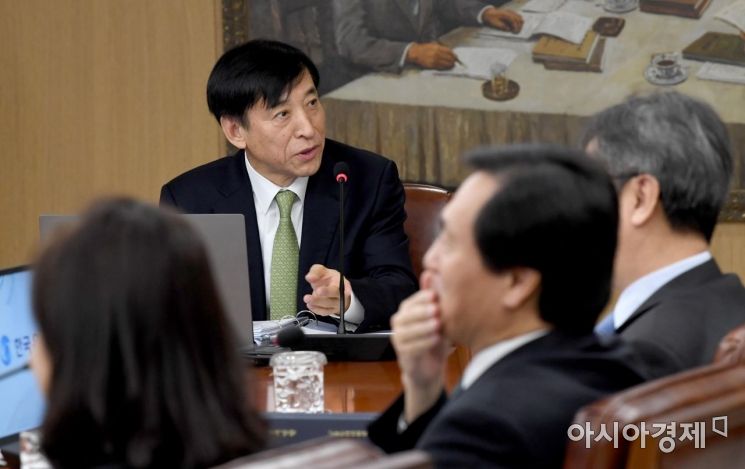 Lee Ju-yeol, Governor of the Bank of Korea, is attending the 'Monetary Policy Direction Financial Monetary Committee' held at the Bank of Korea in Jung-gu, Seoul on the 17th, exchanging opinions with the Financial Monetary Committee members. Photo by Kang Jin-hyung aymsdream@
[Asia Economy Reporters Sim Nayoung, Kim Eunbyeol] The Bank of Korea decided on the 17th at the first Monetary Policy Committee meeting of the new year to keep the base interest rate unchanged at 1.25%. The decision was based on expectations that the export situation in South Korea would improve as external uncertainties eased following the Phase One agreement in the US-China trade negotiations the previous day, and accordingly, the economic growth rate would hit bottom. The Bank of Korea has maintained the base rate at 1.25% for three consecutive months after cutting it twice in July and October last year due to economic sluggishness.
In the monetary policy direction statement released immediately after the meeting, the Bank of Korea stated, "The domestic economy showed signs of partial easing of sluggishness," adding, "Construction investment and exports continued to decline, but facility investment slightly increased and the consumption growth trend expanded." It further forecasted, "This year, GDP growth is expected to be in the low 2% range, broadly in line with the forecast path from last November," and "Although adjustments in construction investment will continue, the slump in exports and facility investment will gradually ease, and the consumption growth trend will moderately expand."
The Bank of Korea identified the government's expansionary economic response policies and progress in US-China trade negotiations leading to a relaxation of global protectionist trade policies as upward factors, while increased geopolitical risks including heightened tensions in the Middle East and the possibility of renewed global trade disputes were cited as downward factors.
Regarding inflation, it reported, "The consumer price inflation rate rose to the high 0% range due to a reduction in the decline of agricultural, livestock, and fishery product prices and an increase in petroleum prices," and "The core inflation rate (excluding food and energy) remained in the mid-0% range, and the general public's expected inflation rate stayed in the high 1% range." It added, "Going forward, the consumer price inflation rate is expected to rise to around 1% this year, broadly in line with the forecast path from last November, and the core inflation rate is expected to be in the high 0% range."
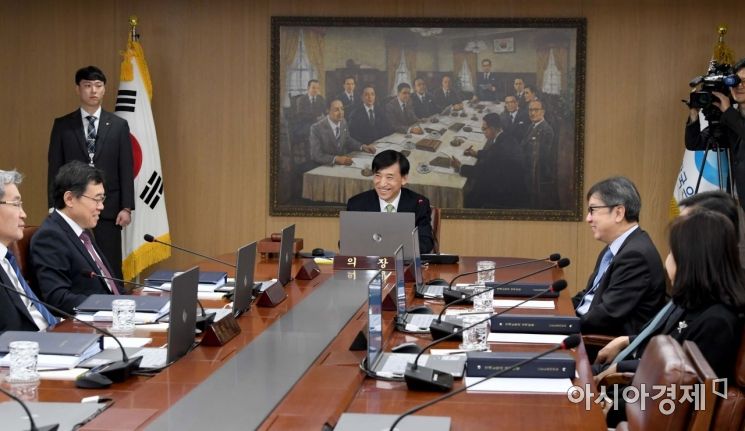 Lee Ju-yeol, Governor of the Bank of Korea, is attending the 'Monetary Policy Direction Financial Monetary Committee' held at the Bank of Korea in Jung-gu, Seoul on the 17th, exchanging opinions with the Financial Monetary Committee members. Photo by Kang Jin-hyung aymsdream@
It also diagnosed, "In the financial market, influenced by movements in international financial markets and expectations of semiconductor industry recovery, stock prices rose and the won-dollar exchange rate fell, while long-term market interest rates fell and then rebounded," adding, "Household loans increased in scale, and housing prices showed a strong upward trend centered on the Seoul metropolitan area."
Regarding future monetary policy direction, it stated, "The Monetary Policy Committee will continue to operate monetary policy to ensure that the growth recovery continues and that inflation stabilizes at the target level over the medium term, while paying attention to financial stability," and "Since the domestic economy's growth is expected to be moderate and demand-side inflationary pressures are projected to remain low, the easing stance of monetary policy will be maintained."
"In this process, we will carefully monitor developments in global trade disputes, major countries' economies, the increase in household debt, geopolitical risks, and their impacts on the domestic macroeconomic and financial stability situation, and judge whether to adjust the degree of easing," it added.
There is also analysis that the Bank of Korea will have no choice but to keep interest rates on hold for the time being to align with President Moon Jae-in's real estate regulation policies. Kim Kyungsoo, Professor Emeritus at Sungkyunkwan University, said, "Lowering interest rates is a decisive factor in rising housing prices, so the Bank of Korea will find it difficult to cut the base rate as it must act as a safeguard," adding, "Since the US is also unlikely to lower its base rate this year, the Bank of Korea is likely to maintain the current rate."
© The Asia Business Daily(www.asiae.co.kr). All rights reserved.
![Clutching a Stolen Dior Bag, Saying "I Hate Being Poor but Real"... The Grotesque Con of a "Human Knockoff" [Slate]](https://cwcontent.asiae.co.kr/asiaresize/183/2026021902243444107_1771435474.jpg)

















