Ministry of Health and Welfare Plans Operation Based on Five Regional Trauma Centers
Original Plan Revised Amid Criticism of "Low Economic Feasibility"... Distributed by Region
Support Budget per Center Drastically Cut from 100 Billion KRW to 10 Billion KRW
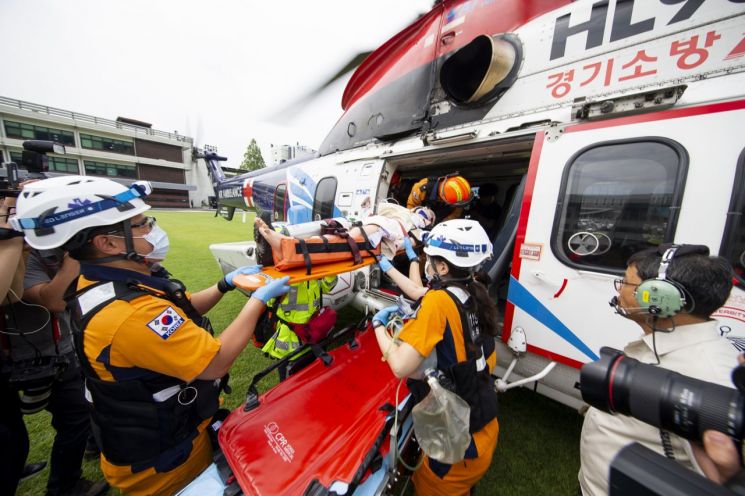 In August last year, paramedics and hospital staff conducted an emergency medical helicopter simulation drill at Ajou University Hospital, which houses the Gyeonggi Southern Regional Trauma Center.
[Asia Economy Reporter Choi Dae-yeol] In 2009, the government announced plans to establish a "Korean-style specialized trauma emergency medical system," dividing the country into 3 to 5 regions and building regional trauma centers as metropolitan hubs. Subsequently, a research team led by Professor Kim Yoon of Seoul National University College of Medicine, commissioned by the Ministry of Health and Welfare, concluded in 2011 that one regional trauma center per each of six regions was appropriate. This conclusion was drawn after running simulations that comprehensively considered expected patient numbers, transport systems using helicopters, and center utilization rates. They also estimated that establishing facilities would cost about 79 billion KRW per center.
The Ministry of Health and Welfare also drafted a detailed project plan with similar content, but the Ministry of Strategy and Finance, which holds budget authority, rejected it. Earlier, the Korea Development Institute (KDI) had analyzed costs and benefits and found the cost-benefit ratio to be less than 0.5. A cost-benefit ratio above 1 is required to be recognized as economically feasible, but the plan fell far short. The Ministry of Health and Welfare argued that some variables, such as suicide attempts, were not reflected in the calculation process, causing discrepancies, but this was not accepted.
At that time, social interest in trauma centers was high as Captain Seok Hae-gyun, who narrowly survived after almost losing his life during the Aden Bay rescue operation, received treatment. Political circles, including the National Assembly, also supported the initiative. However, contrary to the original plan, the government decided to build trauma centers in 17 regions nationwide. This marked a reversal just two years after the Ministry of Health and Welfare announced the trauma center plan.
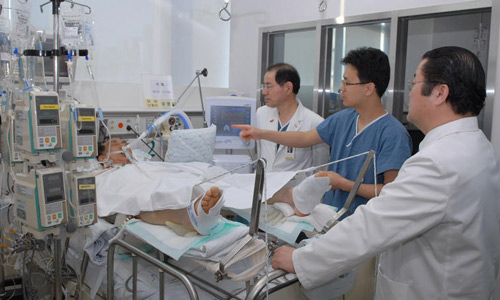 Captain Seok Hae-gyun receiving treatment at Ajou University Hospital in 2011 after sustaining a gunshot wound
Initially, the plan was to classify severity by patient condition and establish graded centers accordingly, but it changed to evenly distributing centers across 16 cities and provinces nationwide. The support budget per center also shrank drastically from about 100 billion KRW to around 10 billion KRW. The current framework of 17 regional trauma centers nationwide was finalized at this time.
There is no clear explanation regarding the specific background. Professor Kim Yoon said in a phone interview, "The original conclusion from the research was to operate about seven large regional centers, but later it changed to building several smaller centers," adding, "The Ministry of Health and Welfare did not provide an official explanation about this."
Inside and outside hospitals, the recent conflict revealed between Professor Lee Guk-jong of Ajou University Hospital and the hospital is also seen as the result of accumulated friction over trauma center operations over several years. Professor Kim said, "Because the trauma centers were made small, dependence on the main hospital inevitably increased," and added, "If they had built large centers from the start, such conflicts would have been fewer, but making them small and leaving the hospital and center issues to be resolved on their own is unlikely to solve anything." He continued, "If the government had decided to build small-scale trauma centers from the beginning, they should have been involved in specific aspects of how hospitals operate trauma centers, but that was lacking."
There are also concerns that chronic manpower shortages in surgical departments make trauma center operations difficult. Choi Seok-ho, director of the Regional Trauma Center at Dankook University Hospital, said, "Currently, there are few residents in departments such as surgery, thoracic surgery, and orthopedics, so it is difficult to dispatch them to trauma centers," adding, "They suffer from heavy workloads and lack adequate financial compensation, making it very challenging to secure personnel."
© The Asia Business Daily(www.asiae.co.kr). All rights reserved.

















