Russian Lower House Approves Successor Prime Minister Appointment One Day After Cabinet Resignation
Former Tax Service Official Mikhail Mishustin Is a Technocratic Bureaucrat Without Political Color
Analysis Suggests Putin May Have Orchestrated Series of Events to Prevent Power Leakage
[Asia Economy Reporter Naju-seok] The Russian parliament overwhelmingly approved the appointment of Prime Minister Mikhail Mishustin on the 16th (local time). It appears that Russian President Vladimir Putin's reshuffling of power is proceeding smoothly.
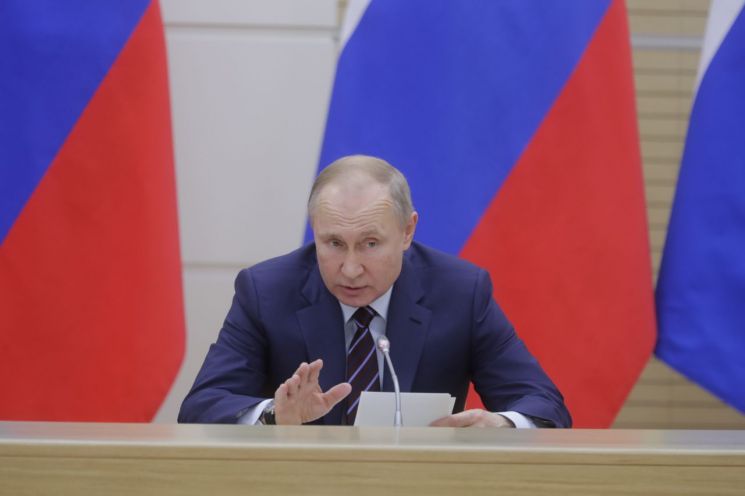
The Russian Duma (lower house) approved the motion to appoint Mikhail Mishustin as prime minister with 383 votes in favor out of 424 members present. There were zero votes against, and only 41 Communist Party members abstained.
The motion to appoint the successor prime minister was passed just one day after former Prime Minister Dmitry Medvedev announced the resignation of the entire cabinet, completing the prime minister appointment process. Medvedev had abruptly announced the cabinet's resignation following President Putin's announcement to push for constitutional amendments the previous day.
There are various interpretations regarding the series of major political events such as the constitutional amendment and the cabinet's resignation.
Foreign media, including the American daily The New York Times (NYT), interpreted President Putin's announcement of constitutional amendments and former Prime Minister Medvedev's cabinet resignation as part of a planned sequence. Generally, foreign media view these moves as part of a series of plans by President Putin, whose term ends in 2024, to establish a framework for lifelong dictatorship.
However, some analyses suggest that these moves were taken to prevent power struggles among Putin's close aides and interest groups.
According to the British daily The Guardian, when the sudden cabinet reshuffle took place, many ministers were not even aware that they had to submit their resignations. Only President Putin and a small circle around him knew about the scenario leading to the constitutional amendment and the cabinet's resignation.
The issue lies in the background of preparing such secretive, coup-level events. The Guardian explained that as President Putin has controlled Russian power for 20 years, power struggles among his close aides have gradually intensified. Moreover, with Putin's term ending in 2024, the possibility of disputes over the next leadership was also increasing. Internal conflicts among close aides, institutions, and interest groups were intensifying.
The sudden appointment of Prime Minister Mishustin, a technocrat from the Federal Tax Service unknown to the public, should also be understood in this context. Russian political commentators and political insiders have reported that internal power struggles over the next leadership have already begun within Russian intelligence agencies such as the FSB.
© The Asia Business Daily(www.asiae.co.kr). All rights reserved.

















