Embrain Trend Monitor Survey
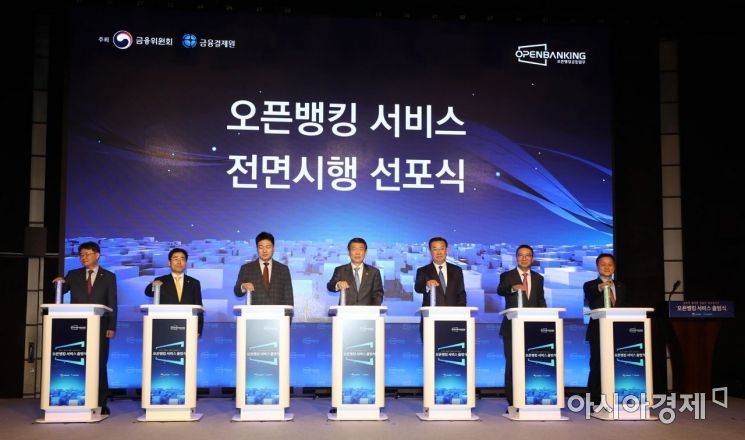 At the Open Banking Service Launch Ceremony held on the 18th at the Westin Chosun Hotel in Jung-gu, Seoul, attendees including Eun Sung-soo, Chairman of the Financial Services Commission, performed the proclamation ceremony for the full implementation of the Open Banking Service. From the left: Yoon Myeon-sik, Deputy Governor of the Bank of Korea; Kim Young-gi, President of the Financial Security Institute; Ryu Young-jun, CEO of Kakao Pay; Chairman Eun; Kim Tae-young, Chairman of the Korea Federation of Banks; Kim Hak-soo, President of the Korea Financial Telecommunications and Clearings Institute; Kwon In-won, Deputy Governor of the Financial Supervisory Service. Photo by Moon Ho-nam munonam@
[Asia Economy Reporter Kim Min-young] Financial consumers agree that open banking in the banking sector is an innovative service, but concerns such as security issues remain significant.
On the 16th, market research firm Embrain Trend Monitor conducted a survey on banking usage and perceptions of open banking among 1,000 adults aged 19 to 59 nationwide who use smartphones. The results showed that 6 out of 10 respondents viewed open banking services as highly innovative in terms of user convenience (59.3%) and believed that financial service usage would become much more convenient if it became widespread (61%).
Additionally, respondents anticipated that the meaning of a primary bank would inevitably diminish in the open banking era (56.2%) and expected competition among banks to intensify in the future (54.2%). With increased competition for customers among banks, there was also a considerable expectation (45.1%) that consumers would receive higher-quality financial services.
However, financial consumers expressed as many concerns as expectations regarding changes brought by open banking services. Among the respondents, 66.7% worried that personal information might be easily leaked due to the introduction of open banking, with high levels of concern across all age groups (20s 64.8%, 30s 63.6%, 40s 64.8%, 50s 73.6%). Furthermore, 47.8% expressed concerns that the nature of managing multiple bank accounts together might lead to collusion among banks.
Security issues were particularly worrisome. Many consumers were concerned that because bank accounts are interconnected, damages from hacking could be severe (52.3%, multiple responses allowed), responsibility for security incidents would be unclear (52.2%), and personal information leakage problems could become serious (43.2%). Alongside this, there were significant concerns that if the stability of open banking is not ensured, large-scale financial risks could occur (38.4%) and security incident issues might increase (37.1%).
The necessity of open banking has yet to strongly appeal to consumers. About half (49.1%) responded that the need for open banking does not resonate strongly with them, and a considerable number (46.8%) felt that even with open banking, there would be little change in actual financial service usage. This indicates a notable gap between the financial sector’s claims of a new paradigm shift and consumer perceptions. In particular, middle-aged and older adults showed less agreement with the necessity of open banking.
Open banking is a service that allows management of all bank accounts through a single bank app and was fully implemented in the banking sector last December. It is scheduled to expand to the secondary financial sector within the first half of this year.
© The Asia Business Daily(www.asiae.co.kr). All rights reserved.
![Clutching a Stolen Dior Bag, Saying "I Hate Being Poor but Real"... The Grotesque Con of a "Human Knockoff" [Slate]](https://cwcontent.asiae.co.kr/asiaresize/183/2026021902243444107_1771435474.jpg)
















