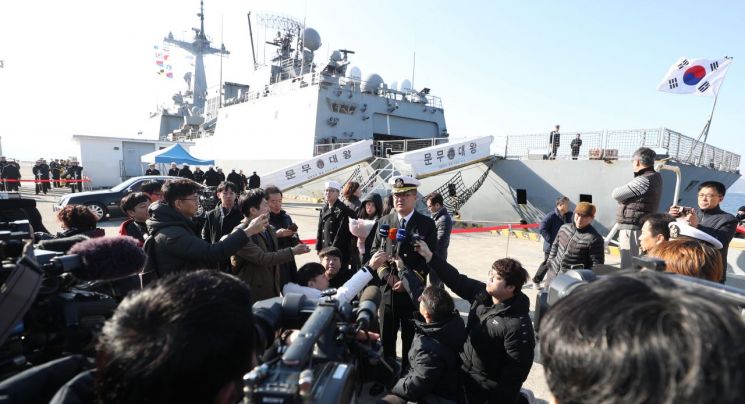
 On the morning of the 15th, at the Navy's cruise training squadron arrival event held at Jinhae Naval Base in Jinhae-gu, Changwon-si, Gyeongnam, reporters asked a Navy official about Professor Lee Guk-jong of Ajou University.
 The Navy official stated that Professor Lee Guk-jong, who had joined the training, left the military base before the arrival event that day. The Munmu Daewang ship seen in the background is the vessel on which Professor Lee was aboard.
[Asia Economy Reporter Choi Dae-yeol] "It is unfortunate that an issue from a few years ago has resurfaced, but I am concerned that this exhausting controversy might become a burden for both Ajou University Hospital and Professor Lee Guk-jong. However, since it is unclear in what context the remarks aired on the broadcast were made, it would not be appropriate for the government to intervene."
After the revelation of the verbal abuse directed by Yoo Hee-seok, director of Ajou University Medical Center, at Professor Lee Guk-jong of Ajou University Hospital through an MBC broadcast report, the aftermath has yet to settle. Although the specific background has not been disclosed, many infer that it is related to the long-standing internal conflicts within the hospital surrounding the operation of the Gyeonggi Southern Regional Trauma Center led by Professor Lee, dating back several years.
The officials at the Ministry of Health and Welfare responsible for supporting the trauma center also share similar uneasy feelings. However, they believe that government intervention is not appropriate in light of the conflict being highlighted by media reports. A ministry official stated, "When conflicts arose over issues such as increasing nursing staff or the inability to allocate beds, we examined the problems and tried to mediate differences in positions, but regarding this matter, there are currently no plans to visit the hospital directly."
Although public interest in this issue has increased, the prevailing view is skeptical about the conflict being easily resolved. Professor Lee has often pointed out to those around him that "normal operation of trauma centers is impossible in Korea," which is not a matter that can be resolved simply by increasing support for the center. Issues such as profitability from trauma center operations, how to allocate limited resources within the hospital, and, on a broader scale, the overall domestic medical service supply system are all intertwined.
Professor Lee has noted that although social attention has risen around trauma centers in the past, a proper system has yet to be established. When Professor Lee became widely known externally after dramatically saving Captain Seok Hae-gyun during the 2011 Aden Bay rescue operation, a consensus on the need to establish a severe trauma center was formed, but this momentum dissipated during subsequent government and political discussions. When I met Professor Lee in October last year, he said, "Frankly speaking, isn't the trauma center support budget increasing thanks to the defector North Korean soldier?" This was a critique of the sudden increase in budget following heightened public interest after treating the defector North Korean soldier in November 2017, which had previously been lacking.
Despite the conflict surrounding trauma center operations becoming public, Ajou University Hospital intends to continue operating the trauma center. Ajou University Hospital operates the trauma center responsible for the southern Gyeonggi region, including Gwacheon and Seongnam. Regional trauma centers are designated by the government if they meet certain criteria; since 2012, 14 centers have been designated nationwide. Three more centers, including in Seoul, are planned to be added, and none have been returned after designation so far. A hospital official said, "We are not considering returning the regional trauma center at all."
© The Asia Business Daily(www.asiae.co.kr). All rights reserved.

















