Woori and Hana Bank Followed by Shinhan Bank Announcing Redemption Suspension for Sold Funds
Among 270 Billion KRW Sales of 'CI Fund', 100 Billion KRW Arbitrarily Flowed into Problematic 'Return Rate Rolling' Funds
Investor Redemption Suspension Inevitable When Shinhan Bank Sold Funds Mature Starting April
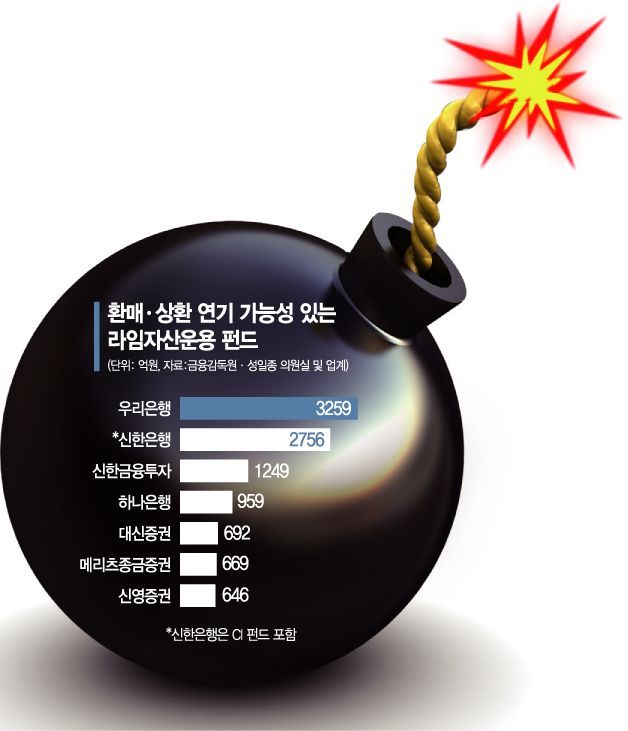
[Asia Economy Reporter Kwon Haeyoung] Lime Asset Management has announced a suspension of fund redemptions to Shinhan Bank, following Woori Bank and KEB Hana Bank. Among the normal Lime funds sold by Shinhan Bank, 100 billion KRW flowed into problematic Lime funds, whose redemptions were suspended last year due to a 'return rate juggling' scheme unknown even to the bank. With the suspension of redemptions for funds sold by Shinhan Bank becoming a foregone conclusion starting this April when maturities come due, the Lime incident appears to be spreading as a time bomb threatening the entire banking sector.
According to financial authorities on the 15th, about 100 billion KRW out of 270 billion KRW of Lime Asset Management's 'Credit Insured (CI) Trade Finance Fund' sold to investors by Shinhan Bank was reinvested into the Pluto fund, whose redemptions were suspended last year.
The CI funds sold by Shinhan Bank are not the three funds whose redemptions were forcibly suspended earlier (Thetis No. 2, Pluto FI D-1, Pluto TF-1). The problem is that within the CI fund series, amounts ranging from 7% to as much as 30% of each fund's investment were reinvested into Lime funds with suspended redemptions without the bank's knowledge. Lime Asset Management notified Shinhan Bank of the possibility of redemption suspension, putting investors who purchased CI funds through Shinhan Bank at risk of losing their investments.
A financial industry official said, "Lime funds have a complex structure where Fund A invests in Fund B, and Fund B invests in Fund C," adding, "Although CI funds still have time until maturity, so investors have not been unsettled, there is a high possibility that redemptions will be suspended when maturity arrives in April, preventing investors from recovering their funds."
It was revealed that Lime Asset Management deceived the selling party, Shinhan Bank, and issued illegal management instructions during this process. Without obtaining consent from investors or the selling party, Lime arbitrarily invested normal fund money into distressed funds, contrary to previously communicated management policies.
A Shinhan Bank official explained, "We belatedly confirmed that Lime Asset Management arbitrarily included CI fund assets into problematic funds without the consent of the selling party or investors," adding, "The management instructions from the asset manager were delivered to the selling party two months later, making it difficult to detect this fact."
Accordingly, the Lime incident shows signs of spreading across the entire banking sector. The bank-specific sales amounts of the three controversial Lime funds were identified as 325.9 billion KRW for Woori Bank and 95.9 billion KRW for Hana Bank. However, with funds from the CI funds sold by Shinhan Bank flowing into problematic funds, Shinhan Bank is effectively involved in selling about 100 billion KRW of these funds, meaning three of the four major commercial banks are implicated in this incident. Kyongnam Bank is also reported to have sold about 20 billion KRW of Lime's CI funds.
Banks express a sense of injustice regarding the controversy over the selling party's responsibility. They argue that the core issue is the asset manager's fraud, not incomplete sales of the product.
An official from a commercial bank said, "The asset manager deliberately deceived by even committing illegal acts, so the selling party had no way of knowing," adding, "We will take all possible measures, including legal action against Lime Asset Management, as soon as the facts are confirmed."
The Financial Supervisory Service (FSS) is also actively responding to the Lime incident. Once the audit results from Samil Accounting Corporation are released at the end of this month, the FSS plans to start inspections of the selling parties to ascertain the facts. The inspection is expected to begin in early February after the Lunar New Year, targeting Woori Bank, Shinhan Bank, Hana Bank, and others.
Regarding the controversy over the selling party's responsibility, it seems that fact-finding investigations must be conducted first. Concerning claims that banks are also victims, the FSS says it is too early to make any presumptions. Although the Lime fund incident, embroiled in a Ponzi scheme controversy, differs from previous major overseas interest rate-linked derivative-linked securities (DLS) issues, internal controls and incomplete sales by selling parties may still become points of contention.
An FSS official said, "Since no inspections have been conducted on selling parties such as banks, it is not possible to discuss their responsibility at this point," adding, "Once the audit results on Lime funds are available, we plan to establish inspection plans and proceed with inspections of banks and others."
© The Asia Business Daily(www.asiae.co.kr). All rights reserved.

















