Net Purchase of 1.8143 Trillion KRW This Year
US-China Tensions Ease & IT Optimism
Upward Trend Expected to Continue for Now
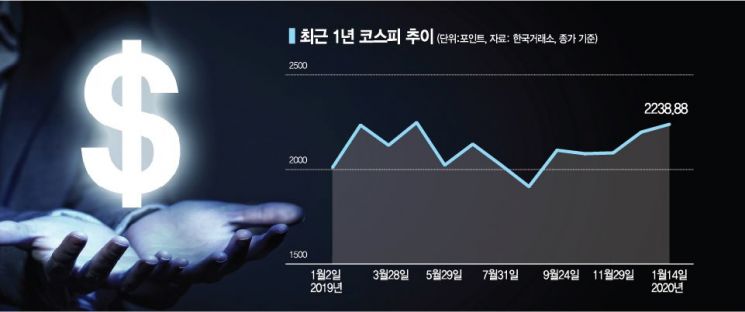
[Asia Economy Reporter Eunmo Koo] As foreign investors who had shunned the domestic stock market throughout the second half of last year return, the KOSPI is approaching its highest point in the past year. With the United States and China poised to sign a Phase 1 trade agreement, concerns over trade conflicts are easing, and expectations for the IT sector, the leading industry in the domestic stock market, continue to rise, leading to increased interest in the KOSPI.
According to the Korea Exchange on the 15th, the KOSPI closed at 2,238.88, up 9.62 points (0.43%) from the previous trading day. Riding a rising trend with gains over the past four consecutive trading days, the KOSPI will surpass the previous high of 2,248.63 points recorded on April 16 last year if it rises more than 9.75 points at the close on this day.
The recent rise appears to be led by foreign investors returning after a period of avoiding the domestic stock market. Foreign investors net purchased 261.9 billion KRW in the domestic securities market alone on the previous day, recording a net purchase of 1.8143 trillion KRW since the beginning of this year. This marks their return after six months since switching to net selling in July last year (net purchase of 2.0316 trillion KRW).
The inflow of foreign capital is analyzed to be due to growing optimism about the international trade environment ahead of the US-China Phase 1 trade negotiations on the 15th (US local time), which has increased interest in emerging stock markets. Additionally, the global stock market is reacting more sensitively to positive news than negative ones after the US government officially removed China from the currency manipulator list on the 13th. Labor Gil, a researcher at NH Investment & Securities, stated, "This removal from the currency manipulator list could lead to optimism for the Phase 2 trade negotiations, which is positive for the stock market."
The KOSPI is also expected to maintain its upward trend. Even when investment sentiment was shaken due to spreading external risks since the beginning of the year, foreign investors continued net purchases centered on large IT stocks. Given the ongoing expectations for industry improvement, the rally is likely to continue for the time being. Lee Jaeman, a researcher at Hana Financial Investment, evaluated, "Considering the recent formation of expectations for improved capital expenditures by global IT companies centered in the US, the possibility of sales improvement across the domestic IT sector looks high, even excluding Samsung Electronics and SK Hynix."
The recent decline in the short-selling ratio is also interpreted as not signaling market overheating. Kim Dongwan, a researcher at Eugene Investment & Securities, explained, "The recent trend in short-selling amounts is determined more by the futures basis (the price difference between futures and spot) than by betting on market direction," adding, "Since November last year, the KOSPI 200 futures price has been highly valued, reducing the demand for spot KOSPI sales by financial investment institutions, which has led to a decrease in borrowed short-selling volume."
Kim further predicted, "This decrease in the proportion of short-selling transaction amounts is expected to continue until the next expiration date when the buy balance of financial investment institutions is liquidated, either next month or the March expiration." According to the Korea Financial Investment Association, the stock loan balance, which is generally considered a leading indicator of short selling, has decreased from a peak of 70.6466 trillion KRW on November 15 last year to 66.1495 trillion KRW as of the 13th.
However, it is pointed out that caution is needed as foreign investors are buying spot stocks but selling futures. Since the beginning of the year until the previous day, foreign investors have net sold 12,203 contracts in the KOSPI 200 futures market. Song Seungyeon, a researcher at Korea Investment & Securities, said, "Looking at past market trends, foreign investors' net short-selling in futures often leads to a 'short-term rise - long-term fall' pattern," adding, "Especially since 2007, this pattern has been observed in all three cases when the KOSPI reached historic highs, so it should be taken into consideration."
© The Asia Business Daily(www.asiae.co.kr). All rights reserved.
![Clutching a Stolen Dior Bag, Saying "I Hate Being Poor but Real"... The Grotesque Con of a "Human Knockoff" [Slate]](https://cwcontent.asiae.co.kr/asiaresize/183/2026021902243444107_1771435474.jpg)
















