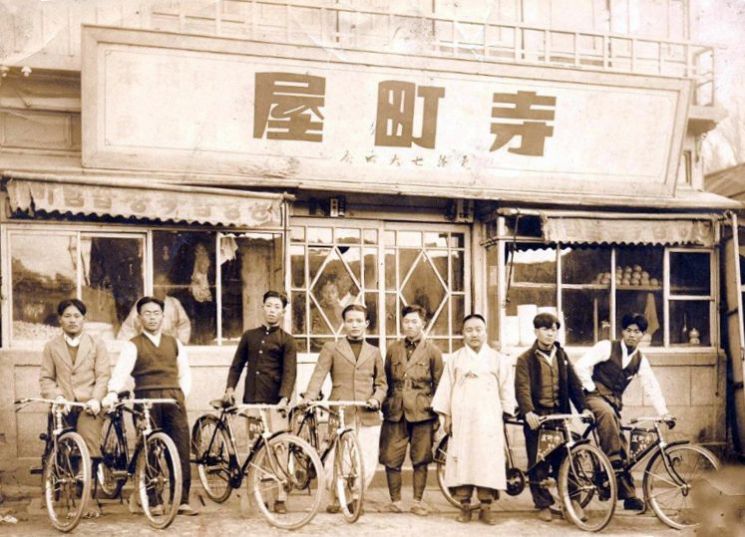
 The image shows a naengmyeon delivery person from Sajungok, a famous noodle house in Incheon, a port city during the Japanese colonial period. Photo by Bupyeong History Museum
[Asia Economy Reporter Kim Heeyoon] Among drinkers, seonju humyeon (先酒後麵), meaning "drink first, then eat noodles," is regarded as an ironclad rule. The origin of this practice?raising a glass before eating noodles at the dining table?dates back to the Joseon Dynasty. While people in the southern regions, known as major granaries, enjoyed rice cakes with alcohol, those from the northwest, including Pyongyang where buckwheat was widely produced, are said to have favored high-proof liquor accompanied by noodles.
Typically, when one thinks of seonju humyeon, naengmyeon (cold noodles) comes to mind. Before liberation, the Korean Peninsula’s naengmyeon was famous mainly for Pyongyang naengmyeon in the north and Jinju naengmyeon in the south. The reason these two types of naengmyeon came to represent the north and south respectively was not only their distinctive flavors but also the convenience of their delivery systems. During the Joseon era, when nobles were highly conscious of others’ views, it would have been difficult for them to visit restaurants located in commoners’ neighborhoods just to eat a bowl of naengmyeon. Thus, records indicate that a naengmyeon delivery culture began to develop.
During the Japanese colonial period, naengmyeon gained immense popularity, even capturing the palates of Japanese people. In response, noodle houses in Pyongyang hired delivery workers called jungmeori right from their opening to formalize the delivery system. The acrobatic delivery of jungmeori, who carried a dozen or so bowls of naengmyeon on wooden trays while riding bicycles, was such a spectacle that it was even depicted in newspaper illustrations of the time. Naengmyeon delivery continued until after liberation but naturally disappeared in the 1960s when the government temporarily banned naengmyeon sales to prevent cholera outbreaks.
If one traces the origins of today’s popular food delivery applications or the explosively growing dawn delivery market, it can be said that they share a connection with the naengmyeon delivery system of the Joseon era. Delivery services that provide efficiency and convenience have become an irresistible consumer trend for the "Baedal Minjok" (Delivery Nation), who first cultivated delivery culture centuries ago.
Convenipremium is a newly coined term combining "convenience" and the English word "premium," referring to the phenomenon where consumers readily open their wallets for convenient products or services that save time and effort. As consumer criteria shift from brand loyalty to convenience and efficiency, new convenipremium services offering minimal time and maximum efficiency have become the defining explanation for the consumption trends of "Baedal Minjok."
© The Asia Business Daily(www.asiae.co.kr). All rights reserved.

















