President Moon "Firm Commitment to Stabilize Housing Prices"
Supports Raising Property Tax and Lowering Transaction Tax
Closely Monitoring 'Balloon Effect' from 12·16 Measures
Experts "Additional Measures Beyond Expectations May Emerge"
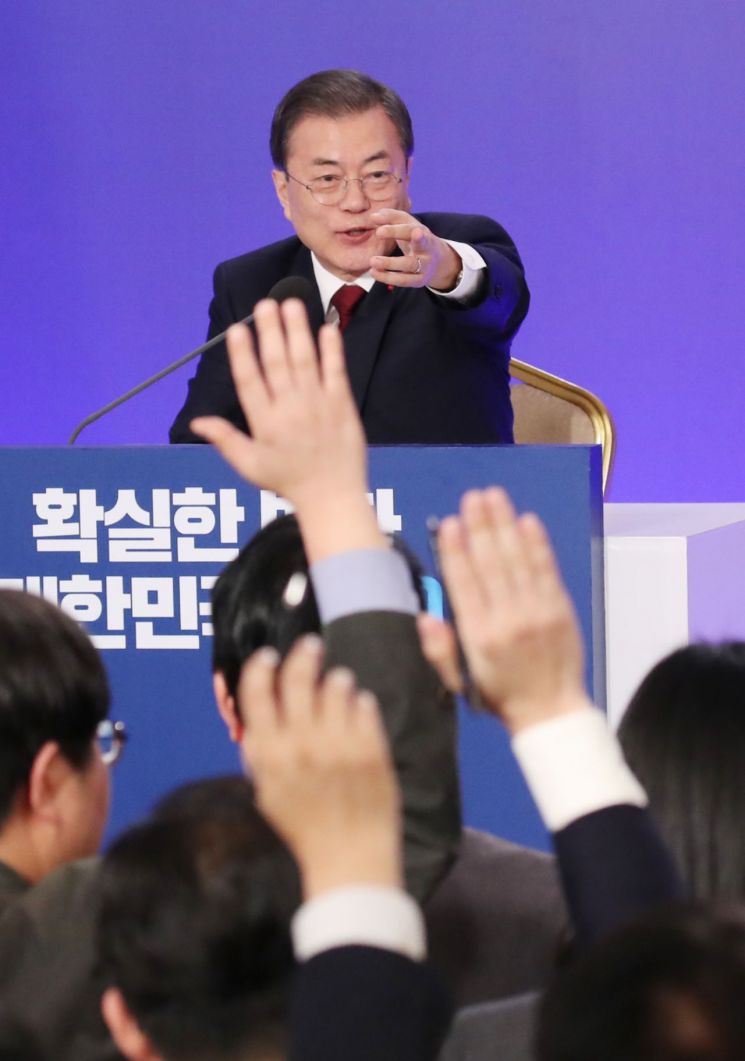 President Moon Jae-in designates a reporter requesting a question at the 2020 New Year's press conference held at the Blue House's Yeongbingwan on the morning of the 14th. (Photo by Yonhap News)
[Asia Economy Reporter Moon Jae-won] On the 14th, President Moon Jae-in once again emphasized that he would "continuously introduce strong measures" to curb real estate prices. Experts predict that since there were balloon effects such as price increases for apartments under 900 million won and a jeonse crisis following the December 16 real estate measures announced last year, the government is highly likely to introduce another 'super-strong measure' within this year.
At a New Year's press conference held at the Blue House's State Guest House that morning, President Moon said regarding real estate measures, "Our determination to curb real estate speculation and stabilize prices is firm," adding, "The goal is not simply to prevent prices from rising any further."
He continued, "We cannot expect the real estate measures to remain effective over a long period," and said, "If we judge that the current measures have expired, we will continuously introduce stronger measures." This expressed his determination once again to firmly control the soaring housing prices during his remaining term.
In fact, after the high-intensity December 16 measures were introduced, the housing market in Seoul's Gangnam area saw a cold atmosphere with urgent sales where prices dropped by hundreds of millions of won, but some balloon effects appeared with prices rising in non-Gangnam areas and metropolitan areas for houses under 900 million won that escaped regulation.
Therefore, experts analyzed that stronger measures such as additional designation of regulated areas could be introduced. Ham Young-jin, head of Zigbang Big Data Lab, said, "In the case of property tax, the ratio of actual transaction prices reflected in the official property price could be gradually increased," adding, "If instability continues in mid- to low-priced areas, additional designation of regulated areas could also be considered."
He added, "The government might lower the loan-to-value ratio (LTV) further, but whether it will do so immediately remains to be seen." President Moon explained that the property tax is effectively increasing due to the realization of official property prices, but emphasized, "Broadly speaking, strengthening property tax while lowering transaction tax is the right direction."
There is also analysis that the deepening jeonse crisis, mainly in Seoul, could be addressed in additional regulations. In fact, jeonse prices for apartments in popular Seoul areas have soared by 100 million to 200 million won in recent months. Although the rise in jeonse prices was prominent in the Gangnam area, where school district demand is concentrated, the increase rates in northern districts such as Yangcheon-gu and Gangseo-gu, where Mokdong apartment complexes are located, and Mapo-gu were not less than those in Gangnam.
Kim Deok-rye, head of the Housing Policy Research Office at the Korea Research Institute for Human Settlements, said, "There might be real estate regulation policies beyond what we have considered," adding, "The current government has been consistently discussing a housing price stabilization plan for over three years since the presidential election pledge." Ham said, "In the jeonse and monthly rent market, measures related to the right to request contract renewal and the rent ceiling system that the government is currently promoting could be introduced."
© The Asia Business Daily(www.asiae.co.kr). All rights reserved.

















