Supply Shortage Compared to Demand and Preference for Risk Assets Also a Factor in Price Increase
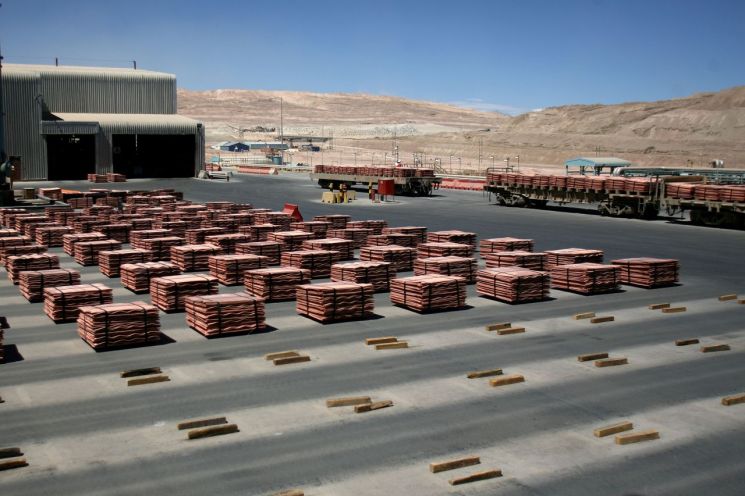
[Asia Economy Reporter Eunmo Koo] After the trade dispute between the United States and China erupted, the price of electrolytic copper (high-purity copper refined by electrolysis) that had been declining is gaining upward momentum again. Optimism is strengthening as the two countries are expected to sign a Phase 1 trade agreement on the 15th, leading to a recovery in prices of industrial metals, especially copper, which are considered risky assets.
According to the London Metal Exchange (LME) in the UK on the 14th, electrolytic copper closed at $6,157 per ton on the 10th (local time). Copper prices, which began to decline from the first half of 2018 when the US-China trade dispute broke out, hit a low of $5,536 per ton in early September last year. Since then, prices have rebounded and risen to around $6,100 currently.
As copper prices have risen, related exchange-traded funds (ETFs) have also shown an upward trend. Since copper prices hit their bottom on September 3 last year, KODEX Copper Futures (H) rose 10.5%, and TIGER Physical Copper increased 4.7% until the day before. The returns on exchange-traded notes (ETNs) were even higher. During the same period, Samsung Leverage Copper Futures ETN rose 22.3%, Shinhan Leverage Copper Futures ETN and Shinhan Copper Futures ETN (H) increased by 16.4% and 11.2%, respectively.
It is evaluated that optimism about the 'US-China Phase 1 trade agreement' has influenced the rise in copper prices by fostering a preference for risky assets. Hwang Byung-jin, a researcher at NH Investment & Securities, explained, "Concerns over trade friction between the US and China have eased, and the Chinese yuan has shifted to a strong trend. The improvement in the yuan's value increases the purchasing power of China, which accounts for more than half of global copper consumption, and alleviates pessimism about global demand forecasts, which is positive for copper prices."
Supply conditions, which are insufficient compared to demand, are also pushing prices up. Electrolytic copper is used comprehensively in various industries such as construction, telecommunications, industrial materials, and transportation, leading to steadily increasing demand. According to the International Copper Study Group (ICSG), copper demand has grown at an average annual rate of 2.8% since the 1990s.
On the other hand, supply cannot keep up with demand as reserves in existing mines are depleted. Bang Min-jin, a researcher at Eugene Investment & Securities, said, "Copper ore production decreased by 0.3% year-on-year in the cumulative third quarter of last year," adding, "The top 20 copper mines in the world account for 35.9% of total production capacity, and many of these mines began mining before 1910, so ore grade depletion is a long-term trend."
However, future price forecasts are somewhat mixed. Researcher Bang said, "If the eased trade conflict further improves Chinese economic indicators, the preference for risky assets will continue," adding, "Initially, copper prices will attempt to recover to the previous high of around $6,500 per ton, and if this resistance is broken, prices could reach the 10-year average of around $6,700 or the average of about $6,900 per ton in the first half of 2018 before the trade dispute intensified."
There are also voices that additional price increases will not be easy. Researcher Hwang said, "The fact that the global manufacturing economy outside China has not emerged from recession will be an obstacle to the price rise trend," and predicted, "The possibility of copper prices maintaining their strength after March is still low."
© The Asia Business Daily(www.asiae.co.kr). All rights reserved.

















