Korea Meets Two Criteria: Current Account and Trade Surplus with the U.S.
Significance of Maintaining South Korea as a Currency Monitoring Country
Positive Market Impact Expected as China Is Removed from Currency Manipulator List
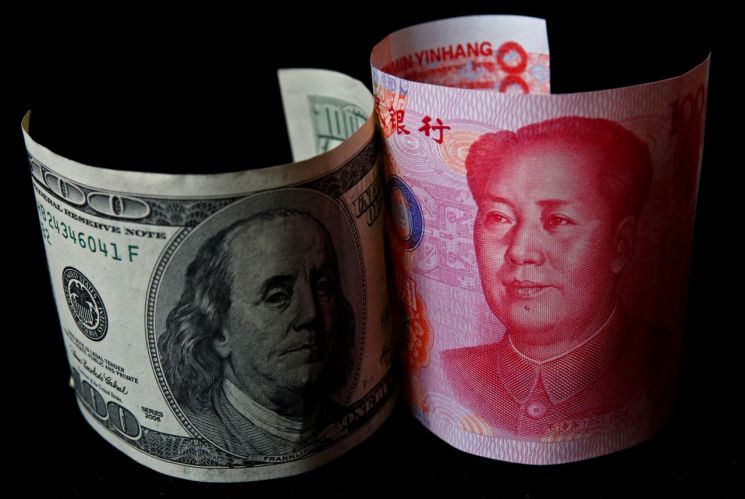
[Asia Economy Reporters Sim Na-young, Kim Min-young] On the 13th (local time), the U.S. Department of the Treasury emphasized in its currency report that South Korea's economic growth outlook is deteriorating and called for active fiscal policies along with labor reforms. The Treasury maintained South Korea as a currency monitoring country due to its current account surplus and trade surplus with the U.S. Being excluded from the currency monitoring list would enhance South Korea's external credibility and reduce the risk perceived by foreign investors in the Korean financial market, making this a regrettable point. However, with China removed from the currency manipulator list, expectations are growing that South Korea's investment sentiment will revive and have a positive effect on the financial market.
In the currency report, the U.S. Treasury stated, "Assuming South Korea's economic growth outlook continues to deteriorate, stronger macroeconomic policies must be ensured," and added, "South Korea has relatively low public debt at 35% of its gross domestic product (GDP), so it has sufficient policy capacity to drive domestic demand," referring to fiscal policy.
It further mentioned that despite a 9.5% increase in the 2019 budget, growth rates have declined and the economic outlook has weakened, reiterating the need for proactive fiscal policies to stimulate domestic demand. The report particularly pointed out, "While fiscal policy is important, structural measures are also necessary to raise potential growth rates," and added, "Comprehensive labor market reforms to resolve labor market duality and further efforts to increase labor force participation can be made."
On the same day, the U.S. Treasury maintained South Korea as a currency monitoring country, citing a $20.3 billion trade surplus with the U.S. and a current account surplus of 4.0% of GDP, meeting two of the three criteria set by the U.S. for monitoring countries. In the first half of last year’s currency report, South Korea was listed as a monitoring country for meeting only one criterion with a current account surplus ratio of 4.4% of GDP. At that time, the Treasury indicated that if South Korea maintained these conditions, it could be removed from the monitoring list in the next report. Accordingly, there were expectations this time that South Korea might be removed from the monitoring list, but the trade surplus with the U.S. exceeding $20 billion led to the maintenance of the monitoring status.
The Treasury welcomed South Korea's commitment to enhancing transparency in foreign exchange market interventions and disclosing intervention details from last year but emphasized that "(South Korean) authorities should limit interventions to exceptional conditions of disorderly market situations." South Korea has been disclosing foreign exchange market intervention information quarterly since the third quarter of last year.
The market expects that considering the fundamental reason the U.S. produces currency reports is to prevent its own trade deficit, it will not be easy for South Korea to be removed from the monitoring list in the future.
Government officials and economic experts are focusing more on China’s removal from the currency manipulator list than on South Korea maintaining its monitoring status. With signs of easing in the U.S.-China trade conflict, which had been a major external risk, global uncertainties are expected to diminish, leading to a revival in exports and recovery in investment sentiment.
A senior official from the Ministry of Economy and Finance said, "Given the already published statistics such as the current account surplus ratio and the size of the trade surplus with the U.S., it was expected that the monitoring status would be maintained, and even if it is maintained, there will be no significant adverse effects."
On the 14th, in the Seoul foreign exchange market, the won-dollar exchange rate opened at 1,153.7 won, down 2.3 won from the previous day. The foreign exchange market, fueled by a risk-on sentiment, expects the won to continue strengthening. The KOSPI also started the day on an upward trend, rising 14.51 points (0.65%) to 2,244.52 as of 9:02 a.m.
A senior official from the Bank of Korea explained, "Recently, the yuan has strengthened, causing the yuan-dollar exchange rate to fall, and this positive factor has been partially priced in," adding, "This U.S. measure will further restore investment sentiment."
© The Asia Business Daily(www.asiae.co.kr). All rights reserved.

















