As the Three Kindergarten Laws Pass, 'Trick Evasion' Movements Spread
Civic Groups Demand "Recovery of Unjustly Executed Funds Before Closure Procedures"
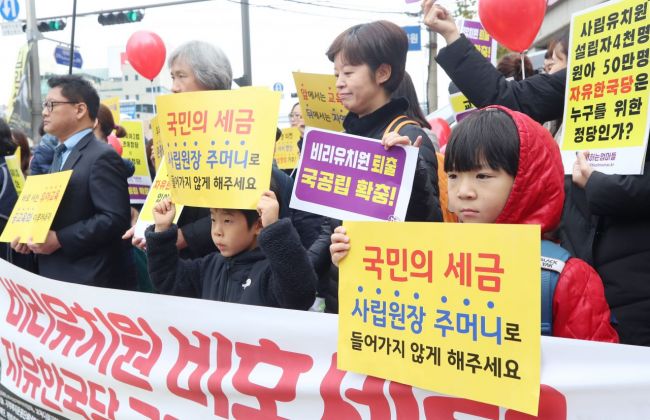
[Asia Economy Reporter Jo In-kyung] "We were treated as a corrupt kindergarten just because our tuition fees were slightly higher and we had more students than nearby kindergartens. During the education office audit, accounting errors from several years ago were found, and we explained each one in detail. Our kindergarten parents have no complaints, but the education authorities keep finding fault."
"Why is it wrong to request that the facility usage fees of the kindergarten be properly reflected? We did not invest elsewhere and provided all the land and buildings when building the kindergarten, so why is private property not recognized?"
As the so-called 'Kindergarten 3 Acts (Amendments to the Private School Act, Early Childhood Education Act, and School Meal Act)' passed the National Assembly, private kindergartens, feeling burdened by the government's strengthened management and supervision, are strongly protesting and considering voluntary closures. There are concerns that if private kindergartens continue to close one after another, a shortage of kindergarten supply will persist in the Seoul metropolitan area, including Seoul.
The principal of a private kindergarten in Gangdong-gu, Seoul, said on the 18th, "After going through a rough patch at the end of the year before last, several nearby kindergartens changed their signs to English academies or play schools and are operating without issues," adding, "(The government) has made it so that even closures cannot be done freely, but we will persuade parents who prefer differentiated curricula and hire professional teachers to change the business type as soon as possible."
Another kindergarten official in Mapo-gu, Seoul, lamented, "The founder principal is not in good health and is at retirement age, but since no money can be received from the kindergarten except the principal's salary, he wants to close the kindergarten rather than continue."
The trend of private kindergartens leaving has already accelerated over the past 2-3 years. The number of private kindergartens nationwide was 4,282 in 2017, 4,220 in 2018, and 3,978 in 2019, decreasing by more than 300 in two years. In Seoul alone, 77 private kindergartens closed. Meanwhile, during the same period, the number of public kindergartens nationwide increased only slightly from 4,744 to 4,856, an increase of 112.
Among the Kindergarten 3 Acts, the amendments to the Private School Act and Early Childhood Education Act will be enforced six months after promulgation, and the amendment to the School Meal Act will be enforced one year later. The national management accounting system (Edufine), which all kindergartens must use, will be mandatory starting March 1.
Going forward, private kindergartens operated with government subsidies and parental fees will be thoroughly managed according to the government's accounting system, and all income or assets of kindergartens cannot be used for purposes other than education. Kindergarten accounting fraud will be punishable by 'up to 2 years imprisonment or a fine of up to 20 million won.'
Parents sending their children to kindergartens welcomed the passage of the bill. Kim (38, Seogyo-dong, Seoul), who has children aged 4 and 6, said, "Since we have no choice but to send our children to private kindergartens, even if it costs more, it is worth it if they can receive safer and better education," and urged, "Please allow parents to directly check and trust all information about kindergarten operations and accounting management."
There are also calls for more thorough on-site audits because even with the full introduction of Edufine, corruption such as side contracts with suppliers of teaching materials, teaching tools, food ingredients, or after-school teachers cannot be detected.
The civic group Moms in Politics said, "Edufine is only a minimum measure and not a corruption solver," and pointed out, "For kindergartens trying to 'run away after embezzlement' now that accounting supervision is strengthened, a comprehensive audit must be conducted, and any improperly executed amounts must be accurately recovered, and if there is any tax evasion, all taxes must be paid before closure."
© The Asia Business Daily(www.asiae.co.kr). All rights reserved.

















