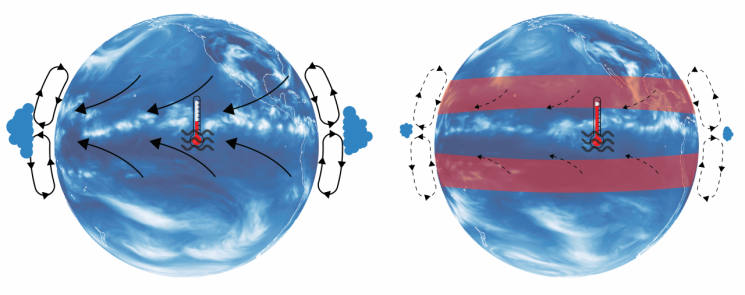
 The diagram on the left is a schematic of the Hadley circulation under current climate conditions. The loops on either side represent air rising in the tropics and descending in the subtropics. The diagram on the right shows the increase in temperature in tropical regions due to global warming. When the temperature in the subtropical regions rises, the Hadley circulation weakens (dashed lines), cloud cover in the tropics decreases, and upwelling of cold seawater is reduced. As a result, the temperature in the tropical regions increases.
[Asia Economy Reporter Junho Hwang] Domestic researchers have uncovered why the effects of global warming vary by region. A research team led by Axel Timmermann, head of the Climate Physics Research Group at the Institute for Basic Science, announced on the 14th that greenhouse gases originating from the subtropical regions exacerbate temperature increases in tropical areas.
The team revealed why sea surface temperatures in tropical regions are higher than in other parts of the Earth. Rising tropical sea surface temperatures promote phenomena such as El Ni?o and destabilize weather and rainfall patterns. While the global average sea surface temperature rose by 0.55 degrees over the past 50 years, temperatures in tropical regions excluding the eastern Pacific increased by 0.71 degrees.
Subtropical Greenhouse Gases Heat Up the Tropics
 Malte Stuecker, Assistant Professor at the University of Hawaii (left), Axel Timmermann, Director of the Climate Physics Research Group
To identify the cause of tropical temperature rise, the research team separated the contributions of greenhouse gases originating from tropical and subtropical regions. They created climate models for both tropical and subtropical areas, conducted experiments simulating increased carbon dioxide concentrations, and analyzed atmospheric and oceanic circulation processes.
They found that carbon dioxide from subtropical regions raises tropical sea surface temperatures by 40% more than the same amount of carbon dioxide from tropical regions. The researchers observed that as temperatures rose in the subtropics due to increased greenhouse gases, the temperature difference between the equator and subtropics decreased. This weakened the Hadley circulation. Consequently, trade winds and upwelling phenomena diminished, leading to increased tropical sea surface temperatures. Additionally, the amount of water vapor transported by trade winds to tropical regions decreased. This resulted in reduced cloud cover and increased solar radiation in the tropics, causing a significant rise in tropical temperatures.
The tropics and subtropics interact through a large-scale atmospheric circulation called the Hadley circulation. Warm, humid air in the tropics converges and rises, moving north and south. As this air descends in the subtropics, it transports cooler air from the upper atmosphere to the surface. Then, trade winds carry the cool subtropical air back to the tropics. This process also causes upwelling, which brings cold water from deep tropical seas to the surface.
Advancement in Research on Regional Imbalance of Global Warming
 Yoon Kyung-sook, Research Fellow at the Climate Physics Research Group (from left), Jeong Ui-seok, Research Fellow at the Climate Physics Research Group, Choo Jeong-eun, Research Fellow at the Climate Physics Research Group
The research team evaluated their work as a significant advancement in studying the regional imbalance of global warming. Corresponding author Malte Stuecker, assistant professor at the University of Hawaii (former IBS research fellow), said, "Previous models assumed uniform carbon dioxide concentrations globally. It is meaningful that we distinguished different regions and understood how global warming interacts among them."
Co-author Axel Timmermann stated, "This study suggests that reducing greenhouse gases in subtropical regions such as Central and South Asia and the southern United States could impact tropical areas. We plan to further investigate the effects of air quality in addition to greenhouse gases to clarify these correlations."
This study was published on the 14th in the international climate change journal 'Nature Climate Change.'
© The Asia Business Daily(www.asiae.co.kr). All rights reserved.