"Interesting, but nothing more"… Users still far from true immersion
Despite 3 major carriers' competition in immersive content, issues like device discomfort and lack of items persist
Poor business results… Government goes all-in on content development
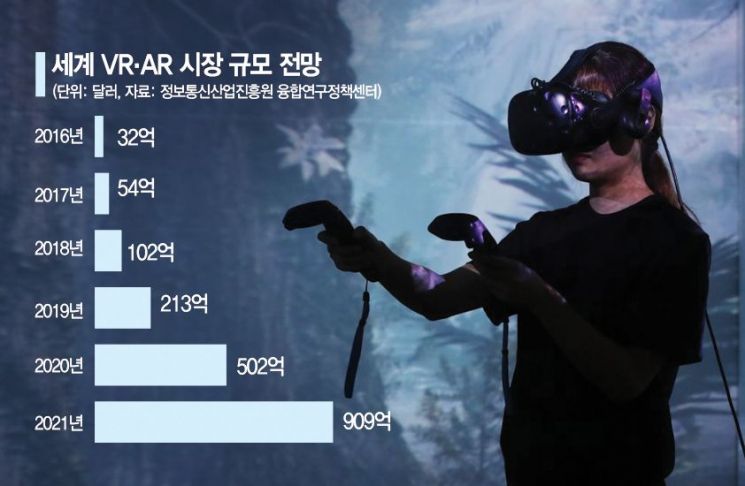
[Asia Economy Reporter Kim Heung-soon] University student Yoo Eun-joo (pseudonym) recently shared information on an online community about her experience at a virtual reality (VR) experience center in Gangnam Station, Seoul. She left her impressions after enjoying a game using a VR device called a head-mounted display (HMD). She evaluated, "While playing a horror game featuring zombies, the immersion of being inside the game was so high that I experienced a 'new world'." However, she added, "There were too many cables connected to the VR, making movement inconvenient, and I felt motion sickness on fast-moving screens," and "It was disappointing that there was a lack of content to enjoy."
◆ Telecom Companies Compete in Immersive Content= In December 2018, the three major mobile carriers began broadcasting 5G signals, and by the end of last year, one year later, the number of 5G subscribers approached 5 million. With the ability to supply high-definition, high-capacity content, the three carriers have focused on expanding immersive content such as VR and augmented reality (AR).
SK Telecom’s ultra-realistic media integrated platform 'Jump AR·VR,' launched in July last year, is a representative example. Through this application, VR users wear HMDs and can become DJs in a club room to enjoy music and dance with other users or have virtual blind dates in a caf? room. Fan meetings and remote conferences are also held virtually. The app also features an AR zoo that realistically depicts animals such as cats, dragons, and pandas. The Jump AR·VR app surpassed 700,000 installations within 40 days of its release. KT operates 'Super VR,' which offers about 10,000 immersive content pieces including VR videos and games. Through VR, users can check real estate listings such as apartments, officetels, and commercial properties without visiting the site or train for interviews with virtual counterparts. LG Uplus also provides over 300 VR contents including performances, movies, games, and webtoons through a 5G-exclusive app and is strengthening efforts to expand AR content. It is cooperating with Google to produce and distribute immersive content.
However, the fact that these services are mostly tailored to individual consumers is pointed out as a limitation. A telecommunications industry official said, "Although AR has been designed for corporate needs, such as experts diagnosing specific machine problems and providing repair methods, verification is needed for pricing and commercialization," adding, "To promote 5G content distribution, the focus is on individual customer services centered on entertainment." Hong Cheol-woon, Senior Vice President of the Virtual Reality Content Industry Association, noted, "The discomfort of wearing HMD equipment is the biggest obstacle to the spread of immersive content," and "Apart from the 5G infrastructure, the lack of a market like PC rooms in the gaming industry is also a limitation."
◆ Government Actively Fosters Immersive Content= The Ministry of Culture, Sports and Tourism, Ministry of Strategy and Finance, Ministry of Science and ICT, and seven other ministries announced the 'Three Major Innovation Strategies for the Content Industry,' including the promotion of leading immersive content, in September last year with President Moon Jae-in in attendance. The aim is to lead budgeting and direction for applying VR and AR to industries.
Starting this year, the government will promote the 'XR (virtual and augmented reality) + α Project,' which proactively integrates immersive content into public, industrial, and scientific fields where new added value is expected through immersive content utilization. Examples of the 'XR+α Project' include remote combat command using AR in the defense sector, hologram remote education at universities in the education sector, VR surgical simulation in the medical field, and AR manual maintenance in the maintenance sector. The 'Gwanghwamun Project' is also being designed to transform the Gwanghwamun area in Seoul?a mix of government offices, cultural heritage, and businesses?into a cultural experience space centered on immersive content.
A Ministry of Culture, Sports and Tourism official said, "Hallyu (Korean Wave) has great global influence, and based on this, Korea attracts many foreign tourists, but there have been criticisms that opportunities to experience Hallyu content in Korea are lacking," adding, "We plan to promote the area so that visitors can experience immersive content in Gwanghwamun and that this region can serve as a tourism hub."
© The Asia Business Daily(www.asiae.co.kr). All rights reserved.
![Clutching a Stolen Dior Bag, Saying "I Hate Being Poor but Real"... The Grotesque Con of a "Human Knockoff" [Slate]](https://cwcontent.asiae.co.kr/asiaresize/183/2026021902243444107_1771435474.jpg)
















