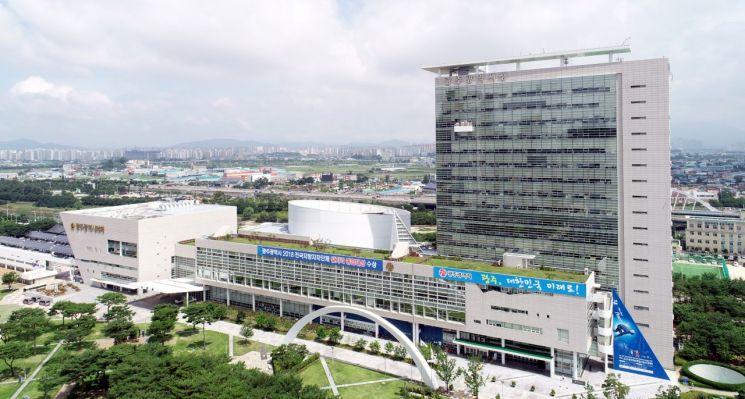
[Asia Economy Honam Reporting Headquarters Reporter Park Seon-gang] Gwangju Metropolitan City announced on the 13th that with the passage of the amended 'Data 3 Laws' (Personal Information Protection Act, Credit Information Act, Information and Communications Network Act) in the National Assembly plenary session on the 9th, the opening and distribution of data essential to the 4th Industrial Revolution have expanded, signaling a green light for the activation of the data economy based on the fusion and utilization of data for the artificial intelligence industry.
The revised Data 3 Laws complement the current system to harmoniously seek the development of related industries through the activation of data utilization while strengthening the protection of personal information. It is expected to further accelerate the AI-centered industrial convergence complex project promoted by Gwangju City.
Key amendments include that under the 'Personal Information Protection Act,' pseudonymized information processed so that specific individuals cannot be identified can be used for purposes such as statistical compilation and research without the consent of the individual.
Additionally, companies can use pseudonymized personal information for commercial purposes without the consent of the data subject and provide it to third parties, and all personal information-related provisions of the 'Information and Communications Network Act' have been transferred to the 'Personal Information Protection Act.'
Data is a core element of artificial intelligence and the most fundamental infrastructure for training AI; as data accumulates, AI technology advances. Securing high-quality industrial training data is one of the core aspects of the AI Data Center, a key facility of the AI-centered industrial convergence complex that Gwangju is promoting.
Regarding the 'Credit Information Act,' pseudonymized information can be used or provided without the consent of the credit information subject for commercial statistical compilation, research, and public interest record preservation, and with the expansion of individuals' credit information transfer rights, it can be mandatorily provided to third-party MyData operators.
This is expected to bring significant changes to data collection policies. It will not only lay the foundation for the 4th Industrial Revolution and activate the big data industry economy but also promote the development of AI industry technologies combined with AI, big data, and deep learning.
In particular, Gwangju aims to realize an AI-centered city with citizen participation, where citizens voluntarily provide data as information subjects, and based on this, new AI products and services are developed to create a virtuous cycle that compensates data providers. The establishment of a legal framework for the essential MyData business aligns with Gwangju’s unique AI industry strategy and is expected to accelerate future data acquisition policies.
Until now, the industry has struggled with the narrow legal scope regarding personal information, hindering the advancement of the AI industry. However, the government's AI national strategy to catch up with leading AI countries and the creation of an AI-centered city in Gwangju are expected to provide significant support.
Son Kyung-jong, Director of the AI Industry Bureau of the city, said, “A legal framework has been established to succeed in the Gwangju-type AI business model that embodies Gwangju’s uniqueness and distinctiveness.” He added, “Following the successful launch of the Gwangju-type job project, a labor-management win-win model led by a local government unprecedented worldwide, we will definitely create a successful model in the ‘intelligent economic war’ that has started globally.”
© The Asia Business Daily(www.asiae.co.kr). All rights reserved.
![Clutching a Stolen Dior Bag, Saying "I Hate Being Poor but Real"... The Grotesque Con of a "Human Knockoff" [Slate]](https://cwcontent.asiae.co.kr/asiaresize/183/2026021902243444107_1771435474.jpg)











