Interview with Ko Young-seok, Head of Planning at Hyundai Mobis
9 Trillion Won Investment Over 3 Years in Electrification and R&D
"Reducing Dependence on Hyundai-Kia Motors to 60% by 2025"
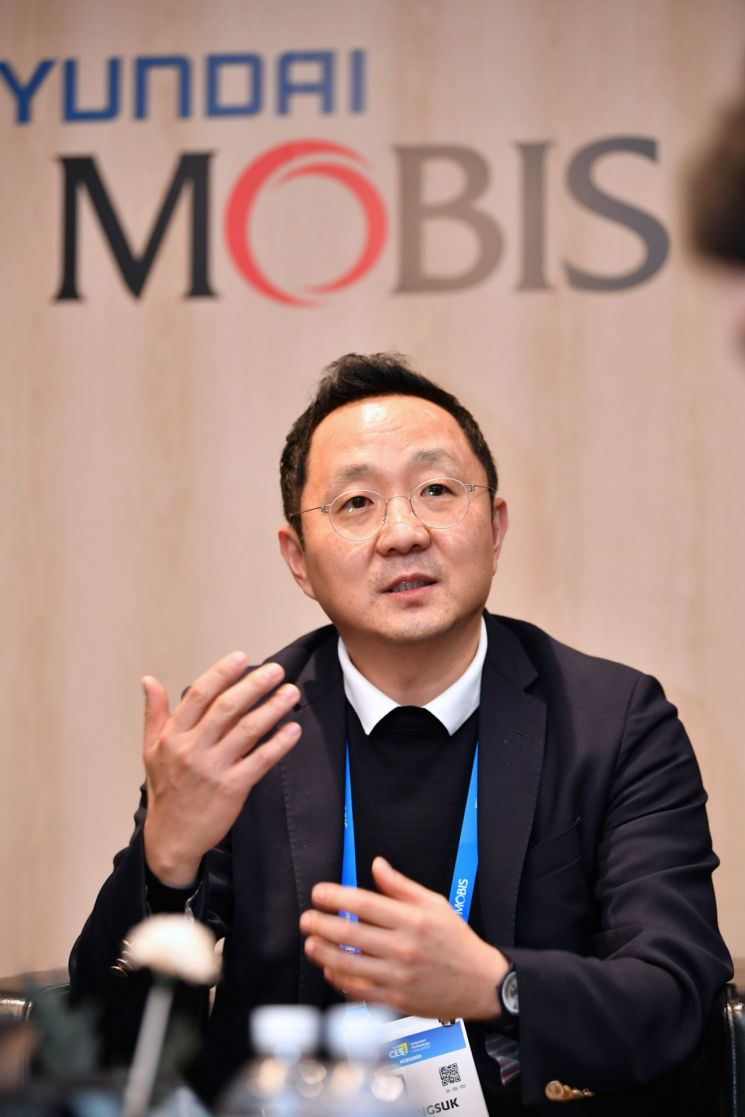
[Las Vegas (USA) = Asia Economy Reporter Kim Ji-hee] "We plan to invest approximately 9 trillion KRW over the next three years in electrification and research and development (R&D)."
Ko Young-seok, Executive Director in charge of strategic investment and new business discovery at Hyundai Mobis, stated this during an interview held on the 7th (local time) at CES2020 in Las Vegas, USA. Ko said, "We see high growth potential in technologies including electrification, autonomous driving, infotainment, and connectivity," adding, "Especially as the era of autonomous driving approaches, other parts and technologies such as braking, steering, and airbags may also change, requiring astronomical investments."
Ko expects the autonomous driving market to be structured by 2030 as ▲Level 2 85% ▲Level 3 10% ▲Level 4 5%. In particular, Level 4 autonomous driving requires more investment because it operates without driver intervention under certain conditions.
Accordingly, Hyundai Mobis is planning a large-scale investment of about 9 trillion KRW. Ko said, "We will invest 4 trillion KRW over three years starting from 2019 to expand production capacity in the electrification parts sector, and 3 to 4 trillion KRW in R&D for technologies and products that will drive growth," adding, "We will also invest more than 150 billion KRW in startups over the next three years." He further added, "We plan to use 1 trillion KRW for shareholder returns, including share buybacks."
Regarding securing future growth engines, Hyundai Mobis faces the challenge of reducing its high dependence on Hyundai Kia Motors. This is because if Hyundai Kia Motors experiences a downturn amid the slowing growth of the global finished car market, Hyundai Mobis’s sales will inevitably face warning signs. Hyundai Mobis aims to reduce Hyundai Kia Motors sales, which currently account for about 90% of total sales, to 60% by 2025. Ko emphasized, "As a global operator, we must achieve a virtuous cycle between Hyundai Kia Motors and other business partners."
Ko predicted, "Since the eco-friendly vehicle market is growing, there is growth potential if we support Hyundai Kia Motors’ growth while investing according to the demand of non-Hyundai Kia Motors customers," adding, "When new markets such as sensors and radar open, the number of products will increase significantly compared to now." He also noted, "It will be challenging because we must be recognized for our technology and reliability from the start when receiving orders from these companies, but it is a path we must take in the mid to long term."
Hyundai Motor announced its future mobility vision at CES2020 based on three pillars: Urban Air Mobility (UAM), Purpose Built Vehicle (PBV), and Mobility Transfer Hub (Hub). Among these, PBV is directly related to Hyundai Mobis’s business area. He said, "The advanced form of the chassis module provided by Hyundai Mobis is the skateboard applied to PBV," adding, "Last year, the module research division completed the first phase of producing an aluminum body sample that forms the basis of PBV." He explained that the possibility of PBV motors connecting to hydrogen fuel cell technology in the long term is also a positive factor for Hyundai Mobis.
However, UAM has many factors to consider due to the characteristics of the aviation industry. He said, "Parts applied to aviation have higher standards than automobiles in terms of temperature, durability, and wear resistance," adding, "We plan to establish related technology development and business strategies considering business feasibility, marketability, technological connectivity, and differentiation."
He also shared the direction regarding the Hyundai Motor Group’s governance restructuring, which was pursued but halted in 2018. Ko said, "From the previous attempt at governance restructuring, we learned the lesson that a market-friendly governance policy is necessary. If we pursue it again in the future, it will definitely be in a market-friendly direction."
© The Asia Business Daily(www.asiae.co.kr). All rights reserved.

















