Half of the Metropolitan Supply Plan is Visible... Only 6% of 40,000 Households in Seoul
Among 3rd Phase New Towns, Goyang Changneung and Bucheon Daejang Have Not Even Been Designated as Districts
[Asia Economy Reporter Lee Chun-hee] Although major apartment prices in the Gangnam area, including reconstruction projects, have turned downward following the December 16 real estate measures last year, the government's plan to supply 300,000 housing units in the metropolitan area is facing setbacks in various locations. While the ultra-strong measures have curbed the soaring housing prices immediately, concerns are rising that without continuous supply expansion, the effect may be only temporary.
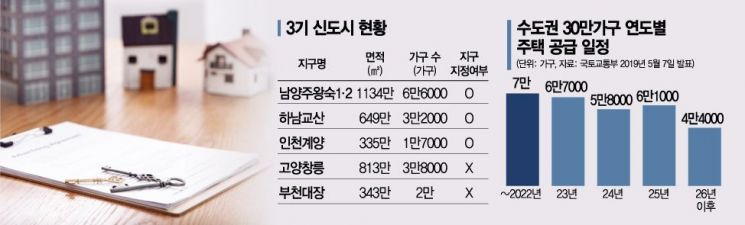
According to the Ministry of Land, Infrastructure and Transport and the Seoul Metropolitan Government on the 13th, only about half of the government's plan to supply 300,000 housing units in the metropolitan area has currently become visible. In particular, in Seoul, out of the planned 40,000 housing units, only 2,400 units are being properly pursued. In Incheon and Gyeonggi areas as well, only slightly more than half of the total 260,000 units, about 150,000 units, have been designated as development districts.
◆ The '300,000 Housing Units' Plan in Limbo= The government announced plans three times?in September and December 2018, and May last year?to supply a total of 300,000 housing units by 2026 across 86 sites in the metropolitan area, including five '3rd Generation New Towns.' The core plan is to supply 173,000 units in the five new towns and develop 81 small to medium-sized sites to supply 127,000 units. By region, the breakdown is ▲Seoul: 62 sites, 40,000 units ▲Incheon: 2 sites, 24,000 units ▲Gyeonggi: 22 sites, 236,000 units.
The six land development districts in the Gyeonggi Province area, which announced supply plans first, initially aimed to complete district designation in the first half of last year and start sales from next year. However, five of these six districts were designated only in the second half of last year. Due to the delayed district designation, subsequent procedures such as implementation plans have also been delayed, which may push back the sales schedule.
Moreover, among the six districts, the 590,000㎡ area around Gwangmyeong Haan 2 district has not even been designated as a district. The government plans to build 5,400 housing units there, but local residents and even Gwangmyeong City have opposed the project. This backlash stems from the government pushing forward the project without considering local supply and demand conditions.
The core of the 300,000 housing units supply, the 3rd Generation New Towns, are also facing difficulties. Namyangju Wangsuk (66,000 units), Hanam Gyosan (32,000 units), and Incheon Gyeyang (17,000 units) have passed the major hurdle of district designation, but Goyang Changneung (38,000 units) and Bucheon Daejang (20,000 units) remain stalled. The Ministry of Land, Infrastructure and Transport plans to complete district designation in the first half of this year after public hearings and strategic environmental impact assessments, but strong opposition from local residents makes the project's normal progress uncertain. Even the three districts that have completed designation are facing opposition, claiming the government is proceeding without principles.
◆ '40,000 Housing Units in Seoul' Facing Various Resident Oppositions= The situation in Seoul is even more serious. Of the total planned 40,000 units, only about 6%, or 2,400 units, are being properly pursued. Even the former Seongdong Detention Center site (1,300 units) has seen its originally scheduled construction start last year postponed to next year. The Seoul Metropolitan Government states that "the entire site is owned by Seoul Housing and Communities Corporation (SH Corporation) and there are no special obstacles," but local residents strongly oppose the city's plan to preserve the watchtower and fences within the detention center, raising concerns about conflicts. The plan to build 2,170 housing units in the Susaek Station area is also being prolonged due to delays in land sales and the announcement of preliminary feasibility study results.
However, the government intends to accelerate the project by completing approval for more than 15,000 units this year through a 'fast track' process that combines entrusted development and housing project approval, and to recruit residents for 1,000 units. The designation procedures for districts in Incheon and Gyeonggi are also planned to be completed in the first half of this year.
Experts emphasize that expanding supply is an essential condition for stabilizing housing prices. Professor Kwon Dae-jung of Myongji University's Department of Real Estate said, "Supply must increase in Seoul where demand exists, but under the current government, concrete supply volumes have been scarce," adding, "Since supply-demand imbalance is a major cause of rising housing prices, expanding supply through revitalizing redevelopment and reconstruction is essential."
© The Asia Business Daily(www.asiae.co.kr). All rights reserved.
![Clutching a Stolen Dior Bag, Saying "I Hate Being Poor but Real"... The Grotesque Con of a "Human Knockoff" [Slate]](https://cwcontent.asiae.co.kr/asiaresize/183/2026021902243444107_1771435474.jpg)
















