[Asia Economy Reporter Yoo Byung-don] Recently, spear phishing has been on the rise again through emails impersonating government agencies. Spear phishing, which in the past deceived users by impersonating hacking groups or delivery companies, is showing increasingly sophisticated forms, requiring users to be cautious.
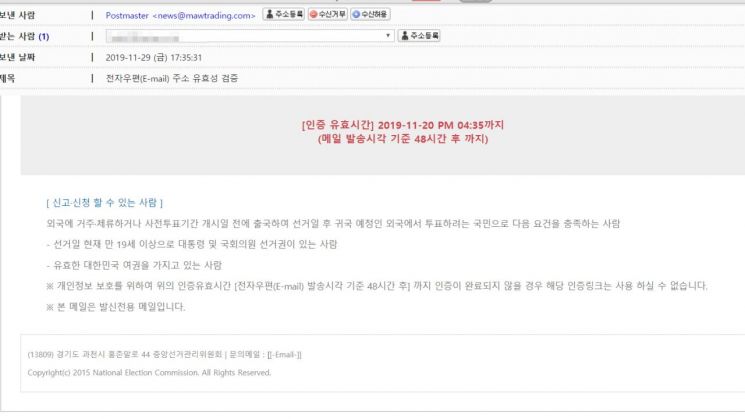
Recently, office worker Park (33) received an email titled "Email Address Validity Verification." The email, impersonating the National Election Commission, contained information about the need to report overseas absentee voting ahead of next year's general election.
It stated that it targeted citizens residing or staying abroad, or those planning to leave the country before the early voting period begins and return after election day to vote abroad, and deceived recipients by saying that authentication was only possible within 48 hours from the time the email was sent, urging them to click a specific link.
However, the email was a spear phishing attempt that installed a file containing malware if the link was clicked. Spear phishing is a method where attackers collect and analyze information about the target in advance and then attack specific individuals or companies.
In the past, most spear phishing emails were written in awkward translations, so paying a little attention could prevent damage, but recently, emails impersonating government agencies like this have been distributed.
When opening the email, phrases such as "Appear at the National Tax Service as a defendant under Article 211 of the National Tax Act" or "Notice of Investigation for Electronic Commerce Violations" are written. If the attached file is carelessly executed, ransomware automatically infects the system. Even the names of officials and clerks are detailed, but all are fictitious.
Experts explain that the only prevention against increasingly sophisticated spear phishing is to follow basic security rules.
A representative from the security company East Security said, "Spear phishing attacks that send malicious emails targeting only employees of specific institutions, organizations, or companies will continue in the future," and advised, "You should make it a habit to follow the most basic but easily overlooked security rules, such as not opening URLs or email attachments from unknown sources."
© The Asia Business Daily(www.asiae.co.kr). All rights reserved.

















