
[Asia Economy Reporter Choi Dae-yeol] # Ms. A, a woman in her 20s, visited a psychiatric clinic due to feelings of depression. She reported insomnia, loss of appetite leading to weight loss, and even a suicide attempt. She attributed her stress to conflicts with her in-laws and her husband's attitude of siding with them. Her husband was at a loss. He was distressed to see his once bright and cheerful spouse suffering from severe depression, despite their good relationship in the early days of marriage.
# Mr. B, an employee at a large corporation, had to receive neuropsychiatric treatment for depression but could not disclose this to his colleagues at work. He had previously been among the top performers, but as his depression worsened, he began missing important tasks and making more mistakes. The dissatisfaction among colleagues, who were unaware of his situation, also increased.
Deterioration of Mental Health Indicators Such as Depression, Anxiety, and Anger Control
"Poor Mental Health" Twice as High in Young Adults Compared to Middle-aged Adults
Reports of individuals with mental illnesses wielding weapons, committing murder, or making extreme choices still surface from time to time. In the past one or two years, several horrific incidents have been widely publicized, raising awareness about mental illnesses such as depression and schizophrenia. Declining mental health is no longer someone else's problem or unrelated to us. While the elderly population increases in an aging society, leading to more cases of mental illnesses like depression, the number of young adults in their 20s and 30s experiencing these issues is rapidly rising in South Korea.
A survey conducted by Professors Kim Na-young and Jang Eun-sun of Bundang Seoul National University Hospital, involving about 200 fellow physicians, found that two out of three respondents exhibited symptoms of burnout. Burnout is a condition where individuals deeply engaged in work experience physical and mental fatigue and lethargy due to continuous work and stress. Among female doctors in their 30s, some showed symptoms of depersonalization, feeling estranged from themselves or experiencing a sense of separation and alienation. This indicates difficulty in managing stress.
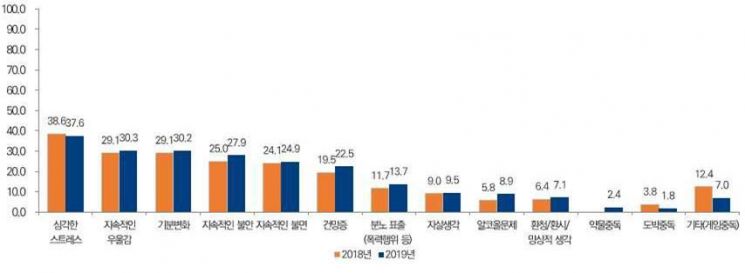
Generally, mental health problems refer to depression or anxiety lasting several days, severe stress, forgetfulness that disrupts daily life, uncontrollable anger outbursts, and addictions to alcohol, drugs, or gambling. According to a survey conducted by the National Center for Mental Health in the second half of last year, more than 60% of respondents reported experiencing such mental health problems. On average, those who reported mental health issues identified about 2.2 problems. The high-risk group experiencing five or more problems accounted for 20%.
The percentage of people who rated their mental health as good was 46.8% (very good + good), the lowest since the survey began in 2015. Compared to 2015, this is a 10 percentage point decrease. The proportion of those who rated their mental health as poor was 11.8% (very poor + poor), the highest in the past five years. Among those who reported poor mental health, young generations aged 10 to 30 were about twice as many as middle-aged groups.
"It will get better on its own" "A problem to overcome alone"
Most endure without hospital or professional consultation and treatment
When looking at types of mental health problems, many cited stress, depression, and mood changes. Additionally, men reported more uncontrollable anger outbursts, while women experienced more anxiety and insomnia. Both survey indicators and individual experiences suggest society is becoming increasingly harmful to mental health.
Nevertheless, efforts to monitor mental health have decreased. When asked whether they make efforts to maintain healthy mental health, about 67% answered yes, which is 7.6 percentage points lower than a year ago. Only about two out of ten people visited a hospital or sought counseling for mental health issues. Reasons given included "I need treatment, but it's not serious, so I think it will get better on its own," "Mental illness is something to overcome by oneself," and "I don't think it will be effective."
Jeon Jin-ah, a research fellow at the Korea Institute for Health and Social Affairs, said, "As crimes committed by patients with schizophrenia have become widely known, interest in mental health issues such as depression and stress has increased across society, leading to greater self-awareness of one's condition. However, while interest has grown, the increase in prejudice against those with severe illnesses is undesirable."
She added, "Domestic health authorities have so far focused on treatment and involuntary hospitalization of patients with severe mental illnesses, but there is a need to expand policies to cover areas experienced by the majority of the population, such as depression and stress."
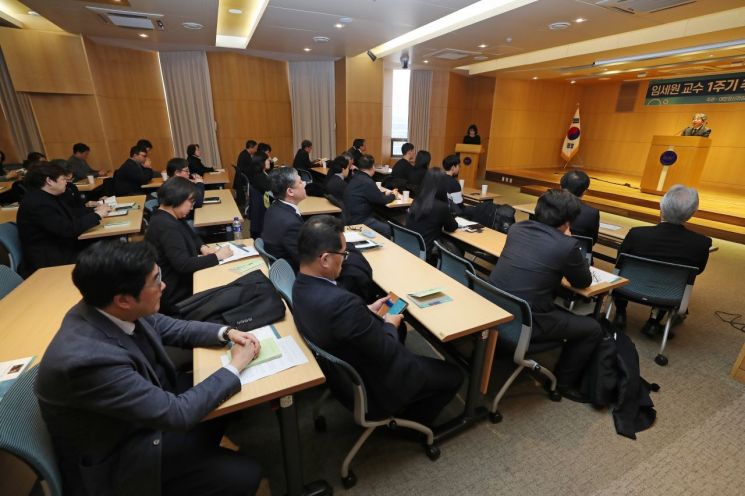 On the 11th, Lee Young-moon, Director of the National Center for Mental Health, delivered a commemorative speech at the first anniversary memorial service for Professor Lim Se-won held at Gangbuk Seongsim Hospital. Professor Lim was stabbed to death by a patient wielding a knife while providing medical care on December 31, 2018.
© The Asia Business Daily(www.asiae.co.kr). All rights reserved.
![Clutching a Stolen Dior Bag, Saying "I Hate Being Poor but Real"... The Grotesque Con of a "Human Knockoff" [Slate]](https://cwcontent.asiae.co.kr/asiaresize/183/2026021902243444107_1771435474.jpg)


















