Passage of the Three Data Laws
Enables Securing Quantity and Quality of Big Data
Pending Tasks Include Amendments to Subordinate Data Laws
[Asia Economy Reporter Junho Hwang] With the passage of the three data-related laws, a foundation has been laid for artificial intelligence (AI) to become even smarter. By enabling the use of more accurate and vast information such as pseudonymized data, qualitative improvements in AI are expected. Revolutionary changes are anticipated in AI industries like precision medicine and fintech.
Improvement in Big Data Quality, Advancement of Artificial Intelligence
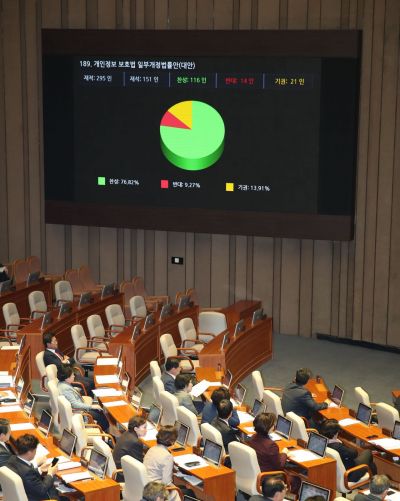
On the 9th, the three data-related laws?the Personal Information Protection Act, the Credit Information Act, and the Information and Communications Network Act?were passed by the National Assembly plenary session, paving the way to utilize pseudonymized information as big data.
Pseudonymized information refers to data from personal information that excludes details that can identify a specific individual. For example, "Hong Gil-dong, 30 years old, male, 010-0000-0000" is personal information, but "HongXX, in his 30s, male, 010-XXXX-XXXX" is pseudonymized information.
As the substance of information becomes more transparent, the accuracy of big data compiled from such information also increases, making the AI trained on it smarter. Smarter AI means building AI that is more personalized. For example, it can recommend products or content optimized for a specific individual. Precision medicine using a particular person's medical data also becomes possible. Conversely, it is also possible to aggregate various specific data to identify a tendency or propose solutions to problems.
In the industry, the legal scope for personal information has been narrow, making it difficult to advance AI. Korea’s AI is evaluated to be about two years behind the leading country, the United States. According to the ICT Technology Level Survey Report by the Institute for Information & Communications Technology Planning & Evaluation (IITP), Korea’s AI technology level is at 81.6% of the U.S. level. Big data stands at 83.4% of the U.S., the lowest among major countries.
Finally, Full-Scale Response to the 4th Industrial Revolution
 Park Yong-man, Chairman of the Korea Chamber of Commerce and Industry, posted on SNS, "Hooray! Finally, the Data 3 Act has passed!! Thank you very much to everyone who worked hard."
The industry agrees that it can now fully respond to the 4th Industrial Revolution. The Korea Chamber of Commerce and Industry stated, "Data is like crude oil in the era of the 4th Industrial Revolution. Developing new business models in new industries such as big data and artificial intelligence, as well as enabling companies to quickly grasp and respond to customer demand and market trends, is expected to be a great help."
The sectors expected to benefit most are healthcare, finance, and telecommunications. The pharmaceutical and bio industries are placing hopes on AI for new drug development. They evaluate that a path has been opened to develop new drugs using smarter AI through health and medical big data such as medical information, genomics, and lifestyle health data.
The fintech industry also believes that the breakthrough for financial innovation has been made. The Korea Fintech Industry Association said, "With the passage of the 'three data laws' in the National Assembly plenary session, the foundation for the 4th Industrial Revolution has been established. If the legal and institutional basis for fintech continues to be established and innovation and growth continue, Korea’s fintech technological capabilities and ICT infrastructure-based financial industry will ultimately lead Korea’s future growth."
The telecommunications industry expects the 5G B2B industry to take off in earnest. 5G is the world’s first commercialized mobile communication network launched last year, offering speeds up to 20 times faster than LTE. The telecommunications industry is attracting general consumers through new 5G services such as gaming, virtual reality (VR), and augmented reality (AR). However, the ultimate 5G customers they aim to secure are enterprises. The goal is to utilize 5G as the main artery of the data economy in autonomous vehicles, smart factories, smart cities, and more.
Challenges Ahead for Becoming an AI Powerhouse

The government plans to steadily implement the AI national strategy announced last month along with the amendment of subordinate laws related to the three data laws. However, it is expected to be difficult to reach social consensus on how to handle pseudonymized information and penalties for personal information leaks.
Civil society groups are opposing the passage of the three data laws in the National Assembly, claiming that "information rights have been stolen." Civic groups such as People’s Solidarity for Participatory Democracy and the Citizens’ Coalition for Economic Justice issued a statement saying, "They have opened the way for companies to widely access and manage individuals’ credit and disease information for profit-seeking purposes," emphasizing, "We will devote all possible means, including constitutional lawsuits and public campaigns, to re-amend the three laws that infringe on information rights."
© The Asia Business Daily(www.asiae.co.kr). All rights reserved.



















