LGBTQ+ Community Urges Use of 'Gender-Neutral Restrooms'
Some Women Fear 'Female Crime'... Restrooms Seen as Most Unsafe Places
US White House and Universities Install Gender-Neutral Restrooms One After Another
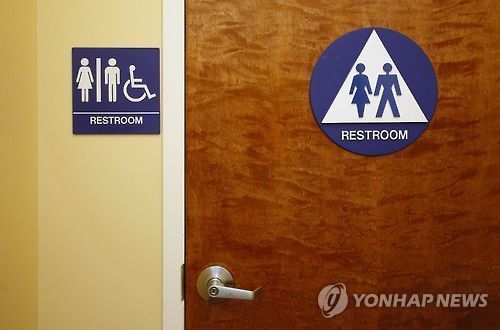
[Asia Economy Reporter Han Seung-gon] Conflicts between men and women are emerging over 'gender-neutral restrooms.' Gender-neutral restrooms differ from unisex restrooms and refer to restrooms that can be used by everyone, including sexual minorities such as LGBT (lesbian, gay, bisexual, transgender), without gender-based distinctions.
The problem lies in the opposing public opinion. Some women argue that before considering the accommodation of sexual minorities, it is inevitable that those who are not women initially have a weaker perception of 'crimes against women,' and thus they cannot sympathize with the demands of sexual minorities for the installation of gender-neutral restrooms.
According to an actual survey, women identified 'restrooms' as the place where they feel the most anxiety. Crimes related to illegal filming continue to increase.
However, sexual minorities such as transgender people claim that opposition to gender-neutral restrooms is a form of discrimination, and the debate surrounding this continues.
A woman in her mid-20s, Ms. A, who works and opposes the installation of gender-neutral restrooms, said, "There have been cases where transgender individuals who identify as women but are biologically male have been incarcerated in women's prisons and sexually assaulted female inmates," adding, "I am not against such restrooms, but naturally, there is a sense of anxiety."
Another woman in her early 30s, Ms. B, also working, stated, "Biologically female, but it is true that males generally have superior physical strength and abilities compared to females." She argued, "If a crime occurs, one would be helpless."
She added, "'Gender-neutral' means two genders, male and female, right? Then both men's and women's restrooms can be used, which is not logically understandable. However, I hope our society discusses this issue well."
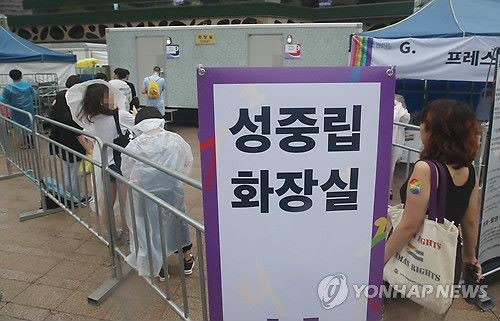 On July 15, 2017, a gender-neutral restroom was installed at the 18th Queer Culture Festival held in front of Seoul City Hall in Jung-gu, Seoul. [Image source=Yonhap News]
◆ Transgender People, Fear of Discrimination Leads to Avoiding 'Restroom' Use
Amid opposition to the installation of gender-neutral restrooms, transgender individuals have been found to often avoid using restrooms due to everyday discrimination.
According to a 2014 National Human Rights Commission survey, 41.1% of transgender respondents reported having avoided using restrooms out of fear of discrimination.
Not being able to use gender-neutral restrooms causes significant distress for transgender people, as they literally have to endure physiological needs.
In 2009, Kyle Giard-Chase, a transgender high school student in Vermont, USA, demanded gender-neutral restrooms and appealed, "From the moment I arrived at school at 8 a.m., I had to hold back going to the restroom. I had to endure until classes ended at 4 p.m., or face violence if I went."
Earlier, a 2008 UCLA Law School survey found that 68% of sexual minorities experienced verbal abuse in restrooms, and 9% reported physical assault.
Regarding this, there is a claim that concerns about crimes related to transgender people's use of gender-neutral restrooms stem from simple misunderstandings. Generally, restrooms used by non-transgender people have the following structures: men's restrooms have urinals and toilets, while women's restrooms have only toilets.
In contrast, gender-neutral restrooms have individual locking doors for each stall and are equipped with both sinks and toilets. The design prevents encountering unfamiliar people of the opposite or same sex.
◆ U.S. White House Installed 'Gender-Neutral Restrooms' in 2015... Followed by Universities
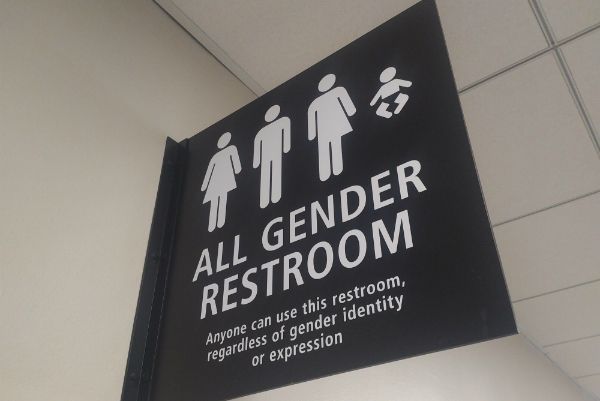
Meanwhile, in 2015, former U.S. President Obama installed gender-neutral restrooms in the White House. In 2016, the New York City Council passed an ordinance eliminating gender distinctions in all public restrooms citywide. The ordinance mandates the removal of gender separation in single-occupancy restrooms and requires gender-neutral signage.
Cities like San Francisco, Philadelphia, and Washington D.C., including the University of California (UC) system, have introduced gender-neutral restrooms in 150 universities across the U.S.
In the UK, Somerville College at Oxford University decided in January 2018 through a student vote to eliminate gender distinctions in restrooms. The proposal to remove gender separation was made by the university's sexual minority group.
The group's representative, Ailid Wilson, stated, "Gender-neutral restrooms aim to raise awareness of the problems that can arise from spaces (restrooms) divided strictly by male and female."
Gender-neutral restrooms are also increasing in countries like Sweden and Canada, and have been installed in Beijing's representative entertainment districts such as Sanlitun and Nanluoguxiang. Japan plans to install gender-neutral restrooms in preparation for the 2020 Tokyo Olympics.
◆ Women Say 'Restrooms' Are the Most Anxious Places... Can Anxiety Be Eliminated?
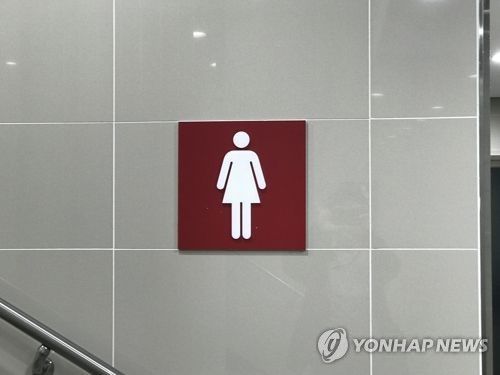
However, concerns about crimes that can occur in restrooms remain. According to a survey, women identified restrooms as the places where they feel the most anxiety.
A survey conducted by Seoul City and the Namu Women's Human Rights Counseling Center from June 23 to 29 last year, targeting 1,500 adult men and women aged 19 to 59 living in Seoul, found that 80% of women responded that they feel anxious in daily life due to illegal filming. This indicates that anxiety about crimes occurring in restrooms persists even before the controversy over gender-neutral restrooms.
Places with high anxiety about illegal filming included △lodging facilities at 43%, △public restrooms at 36%, and △swimming pools and bathhouses each at 9%. Notably, women identified public restrooms as the 'most anxiety-inducing place' (52%).
According to prosecution data, the number of crimes related to illegal filming reached 6,842 cases in 2018, an eightfold increase from 829 cases in 2009.
Experts analyze that the possibility of crimes occurring cannot be ruled out. Dr. Yoon Hae-sung of the Korea Institute of Criminology said in a media interview, "It is difficult to say that sexual crimes occur solely because of restroom structures, but when both men and women can use the same restroom, it creates more opportunities for crimes to occur."
© The Asia Business Daily(www.asiae.co.kr). All rights reserved.



















