[Asia Economy Reporter Junho Hwang] Domestic researchers have announced findings that Parkinson's disease can occur even when dopamine neurons are alive. It is not that Parkinson's disease arises from the death of dopamine neurons, but rather that the disease occurs when dopamine neurons are alive but their function is halted. Attention is focused on the possibility of a new treatment method that inhibits dopamine sleep substances in the early stages of Parkinson's disease to prevent the illness.
According to the Institute for Basic Science on the 10th, the research team led by Director Changjun Lee of the Cognitive Glial Science Group at the Center for Cognition and Sociality revealed that astrocytes in the brain induce Parkinson's disease by putting dopamine cells to sleep. This overturns the existing theory that Parkinson's disease occurs due to the death of dopamine cells. Parkinson's disease is a degenerative brain disorder that causes symptoms such as tremors, muscle rigidity, and bradykinesia. The likelihood of onset increases with age. Dopamine is a neurotransmitter in our brain that enables motor commands and is produced by dopamine neurons in the midbrain.
Parkinson's Disease Occurs When Dopamine Neurons Are Put to Sleep
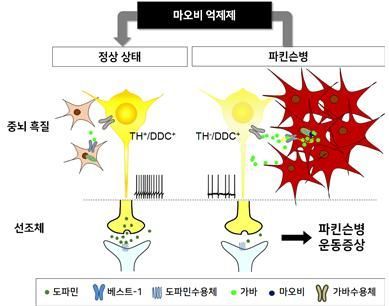
Through this study, the research team discovered that GABA, an inhibitory neurotransmitter excessively secreted by reactive astrocytes, puts dopamine neurons to sleep and induces Parkinson's disease. Astrocytes are the most abundant star-shaped glial cells in the brain. When the number of astrocytes increases and their size grows, affecting surrounding neurons, they are called 'reactive astrocytes.'
The research team conducted experiments administering MAO-B (monoamine oxidase B) inhibitors to mice with Parkinson's disease to block GABA secretion from reactive astrocytes. As the amount of GABA decreased, the dopamine neurons in the Parkinson's mice did not fall asleep. Dopamine production improved, alleviating the mice's motor dysfunction symptoms.
In particular, the team also performed optogenetic experiments stimulating dopamine neurons in mice with light. This experiment involved putting dopamine neurons to sleep or waking them up with light stimulation and observing the resulting changes in step count. The results showed that when dopamine neurons were put to sleep in normal mice, their step count decreased. Conversely, waking dopamine neurons in Parkinson's mice increased their step count. This indicates that the more dopamine neurons are asleep, the fewer steps are taken, and Parkinson's symptoms manifest.
A New Chapter in Parkinson's Disease Treatment
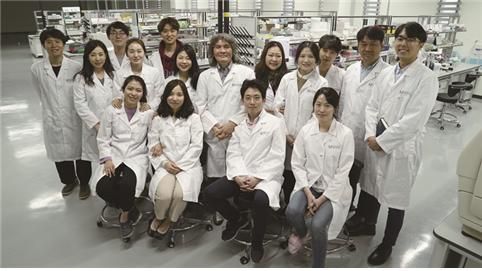
This study overturns the decades-old established theory that 'dopamine dies, causing Parkinson's disease.' Director Lee stated, "Through astrocyte research, we have overturned the existing Parkinson's disease theory and proposed a new direction for treatment." The research team added, "We intend to begin developing treatments using a library of lead compounds that inhibit MAO-B."
Currently, Parkinson's disease treatment involves supplementing dopamine through a drug called levodopa. However, this is not a fundamental solution to prevent Parkinson's disease. Moreover, levodopa can cause serious side effects, causing significant difficulties for patients. The research team expects that since dopamine neurons in the early stages of Parkinson's disease have stopped producing dopamine but are still alive and not dead, regulating GABA could fundamentally treat Parkinson's disease.
Meanwhile, the results of this study were published online on the 10th at 1 a.m. (Korean time) in the international journal Current Biology.
© The Asia Business Daily(www.asiae.co.kr). All rights reserved.



















