Unlike the Minister, Parliamentary Approval Required
Approval Vote for Jeong Scheduled in Plenary Session on the 13th
High Chances of Passage if '4+1' Coalition Cooperates
[Asia Economy Reporter Jeon Jin-young] As the confirmation hearing for Prime Minister nominee Jeong Sye-kyun concluded on the 8th, the ruling and opposition parties have entered the full-scale 'confirmation political battle.' The Liberty Korea Party launched an offensive until the last moment of the hearing, raising suspicions about Jeong's involvement in the development of the Hwaseong Dongtan housing site. With the adoption of the hearing report and the plenary vote remaining, the power struggle between the ruling and opposition parties over the prime minister's confirmation is expected to continue.
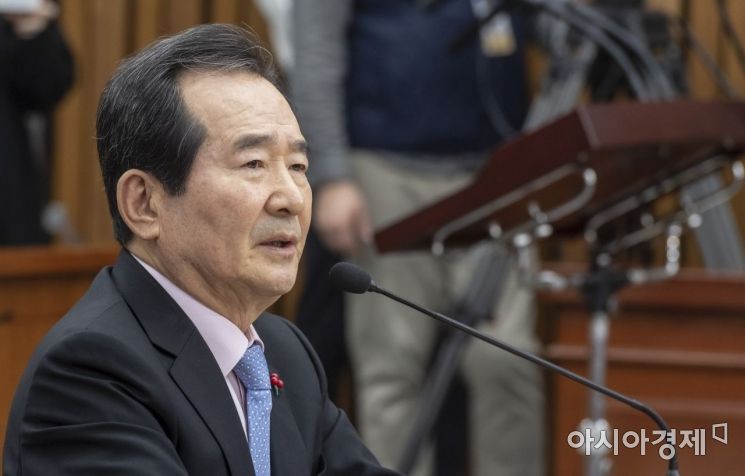 Prime Minister nominee Jeong Sye-gyun is attending the confirmation hearing held at the National Assembly on the 8th, responding to questions from lawmakers. Photo by Yoon Dong-joo doso7@
Unlike other ministerial confirmation hearings, the prime minister nominee must obtain the consent of the National Assembly. This is why the ruling and opposition parties engage in tense battles over 'appointment' and 'rejection' at every prime minister confirmation hearing.
The first case of rejection occurred during the Constituent National Assembly. At that time, Article 69 of the Constituent Constitution stipulated that "the Prime Minister shall be appointed by the President and must obtain the approval of the National Assembly." President Syngman Rhee announced in the plenary session that he would appoint Lee Yun-young, vice-chairman of the Joseon Democratic Party. Since there was no confirmation hearing law, there was no verification process by the National Assembly. Amid the sudden announcement by President Rhee, some members of the assembly suggested, "Then let's decide now." The impromptu vote resulted in 194 present votes, 132 against, and 2 abstentions. This marked the birth of the first rejected nominee.
Since the introduction of the Confirmation Hearing Act in 2000, prime minister nominees have undergone rigorous scrutiny. Allegations of real estate speculation, military service corruption, and false address registration have been major reasons for rejection. During the Kim Dae-jung administration, Jang Sang, former president of Ewha Womans University, and Jang Dae-hwan, chairman of Maeil Business Newspaper, faced controversies over real estate speculation and false address registration, leading to the rejection of their appointment proposals by the National Assembly. Kim Tae-ho, former governor of Gyeongsangnam-do and a rejected nominee during the Lee Myung-bak administration, had no issues with military service or false address registration but withdrew voluntarily amid controversies over involvement in the Park Yeon-cha gate and tax evasion allegations.
The era of former President Park Geun-hye was a 'period of hardship' for prime minister nominees. Many nominees were rejected or voluntarily resigned after appointment. Former Supreme Court Justice Ahn Dae-hee resigned due to controversies over preferential treatment for former officials, and Moon Chang-geuk, former chief editor of JoongAng Ilbo, resigned after making statements that "Japan's colonial rule and the division of the Korean Peninsula were God's will." Subsequently, despite overcoming controversies such as real estate speculation and military service issues, former Prime Minister Lee Wan-koo was appointed but had to resign amid allegations of involvement in the 'Sung Wan-jong list.' At the end of 2017, the Supreme Court acquitted Lee Wan-koo in the final appeal trial on charges of violating the Political Funds Act.
Amid the turbulent 'confirmation hearing path' of past prime minister nominees, the Democratic Party believes that nominee Jeong will be confirmed smoothly. Although the Liberty Korea Party has clearly opposed, the '4+1 (Democratic Party, Bareunmirae Party, Justice Party, Party for Democracy and Peace + Alternative Party) coalition' can secure a majority vote through cooperation.
In the case of Prime Minister Lee Nak-yeon, the Liberty Korea Party left the plenary session during the vote, but the Democratic Party, People's Party, and Justice Party cooperated to pass the National Assembly hurdle with 164 votes in favor and 20 against. Meanwhile, the Democratic Party plans to hold a plenary session on the 13th to attempt a confirmation vote for nominee Jeong.
© The Asia Business Daily(www.asiae.co.kr). All rights reserved.

















