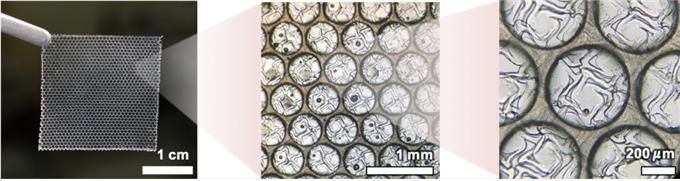
[Asia Economy Reporter Junho Hwang] Domestic researchers have developed a thin film that contracts and expands according to the surrounding temperature, similar to human skin sweat glands. It is expected to be used as a heat dissipation device in wearable devices in the future.
The Electronics and Telecommunications Research Institute (ETRI) announced on the 9th that it succeeded in developing a heat dissipation element that can control heat release without power supply by automatically closing pores when the temperature drops and opening them when it rises at 31℃, which is similar to the surface temperature of human skin.
This heat dissipation element regulates heat through its own contraction and expansion without power supply. When the temperature falls below 31 degrees, similar to the surface temperature of human skin, it expands and closes the pores, and when it rises, it automatically opens to release heat. The researchers made this element using hydrogel, which changes its water absorption depending on the temperature.
The heat dissipation element, measuring 3 cm in width and 3 cm in length, contains 20,000 artificial sweat glands. Its thickness is 70 micrometers (μm, one-millionth of a meter).
The research team expects this element to be used as a heat dissipation device to solve smartphone overheating or as an energy generation device.
Seung-eon Moon, a researcher at ETRI, said, "The commercialization period is expected to be about two years, and large-area application is also possible," adding, "It can be used in wearable devices that diagnose biometric information."
This research achievement was published in Advanced Materials.
© The Asia Business Daily(www.asiae.co.kr). All rights reserved.

















