Iran, Al-Asad, and Erbil US Military Bases Hit by Missile Attacks
Operation 'Martyr Soleimani'
Iran Revolutionary Guards: "US Allies Also Targets If Retaliate"
US Department of Defense: "Will Take All Necessary Measures"
Trump's Cautious Stance, Prepared but Canceled National Address
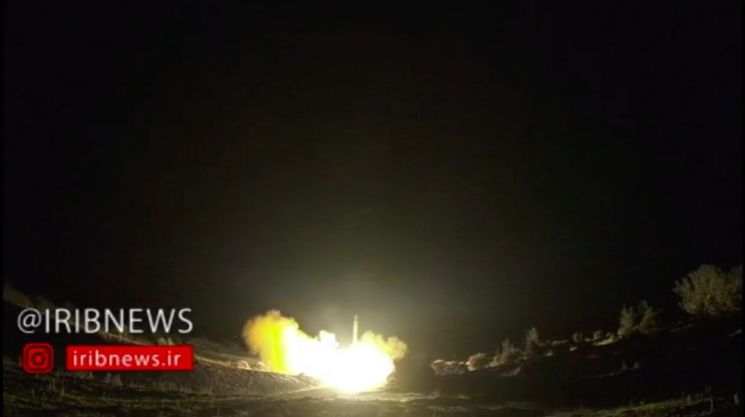
[Asia Economy Reporter Naju-seok] Iran has launched a sudden retaliatory attack against the United States.
On the 8th (local time), both the U.S. and Iranian governments confirmed that Iran had initiated missile attacks on U.S. military bases stationed in Iraq.
The bases hit by Iran's attack were confirmed to be the Al Asad Airbase and Erbil base in Iraq.
Jonathan Hoffman, spokesperson for the U.S. Department of Defense, stated that day, "Dozens of missiles were launched from Iran toward U.S. military bases."
There have been no reports yet on casualties or damage to U.S. forces. Hoffman only mentioned, "The U.S. military is currently assessing the damage."
The U.S. Department of Defense said, "The U.S. military will take necessary measures to protect the United States and its allies."
Al Asad Airbase, located in Anbar Province in western Iraq, has hosted U.S. troops since the U.S. ousted Saddam Hussein's regime in 2003. This base was also actively used in the fight against the Islamic State (IS), a Sunni Islamist militant group. Former U.S. President Donald Trump visited Al Asad Airbase during Christmas in December 2018 to encourage the troops. Erbil base was also the former station of the Korean Zaytun Unit.
Iran named this operation "Martyr Soleimani," clearly indicating it as retaliation for the killing of Qasem Soleimani, commander of the Quds Force of the Iranian Revolutionary Guard Corps (IRGC), by U.S. forces. An IRGC official appeared on Iranian state TV and declared, "The fierce retaliation of the Revolutionary Guard has begun."
The IRGC also left open the possibility of further retaliation. In a statement, the IRGC said, "If the U.S.'s allies join in the U.S. counterattack, their territories will also become targets of our attacks," adding, "If the United Arab Emirates (UAE) participates in the U.S. attacks on Iranian territory, it should say goodbye to its economy and tourism industry." They also declared they would retaliate against Israel.
Ayatollah Ali Khamenei, Iran's Supreme Leader, reportedly stated immediately after confirming Soleimani's death that "Iranian forces must carry out direct and proportional attacks."
Earlier, Commander Soleimani was killed on the 3rd at Baghdad Airport in Iraq by a U.S. drone strike.
The U.S. Federal Aviation Administration (FAA) urgently restricted flights over Persian Gulf airspace following the attack, according to AP News.
President Trump has shown a cautious stance regarding Iran's retaliation. Secretary of State Mike Pompeo and Secretary of Defense Mark Esper visited the White House immediately after Iran's attack. White House spokesperson Stephanie Grisham said, "President Trump has been briefed on the attack on U.S. military bases in Iraq," and added, "The President is closely monitoring the situation and consulting with security officials on response measures."
President Trump was reportedly planning to deliver a national address that day but ultimately canceled it. Spokesperson Grisham said, "President Trump will not be giving a speech today regarding Iran's missile attack."
On the morning the news of Iran's retaliatory attack broke, major Asian stock markets plunged. In Tokyo, Japan, the Nikkei 225 and TOPIX indices fell more than 2%, South Korea's KOSDAQ index plummeted over 3%, and Hong Kong's Hang Seng Index dropped more than 1.5%.
© The Asia Business Daily(www.asiae.co.kr). All rights reserved.

















