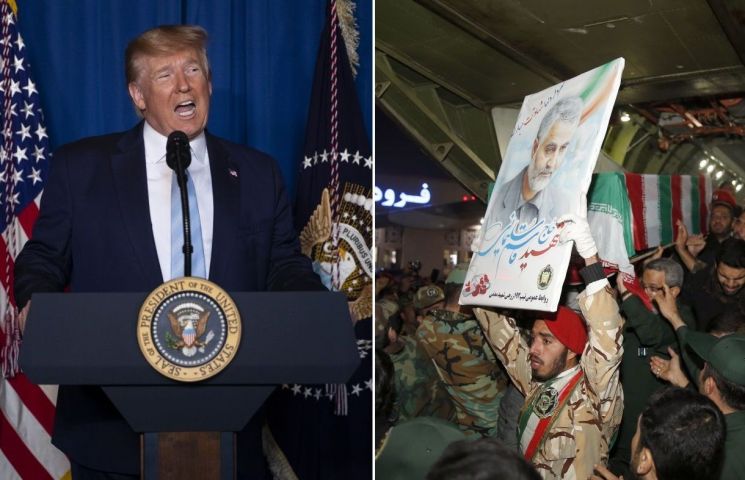
[Asia Economy Reporter Hyunwoo Lee] The confrontation between the United States and Iran has reached a critical juncture. Iran, vowing retaliation against the U.S., concluded the mourning period following the funeral of Qasem Soleimani, commander of the Quds Force, and has begun setting the level of its future response. U.S. President Donald Trump further escalated tensions by stating that Iran will never possess nuclear weapons. The U.S. is reportedly planning to deploy additional airborne and special forces troops to the Middle East, along with strategic bombers. However, since the Trump administration has expressed willingness to renegotiate the nuclear deal (JCPOA ? Joint Comprehensive Plan of Action), and Iran has also left room for negotiation even after deciding to withdraw from the agreement, there are forecasts that the Middle East situation could lead to a prolonged standoff.
According to foreign media including the Associated Press, Iran ended its three-day mourning period on the 6th (local time) with Soleimani’s funeral. Supreme Leader Ayatollah Ali Khamenei attended the funeral, shedding tears as he mourned Soleimani’s death. During the funeral, slogans such as "Death to America" erupted. Attention is now focused on the level of Iran’s response after the mourning period. If Iran begins full-scale retaliation against the U.S., the Middle East crisis is bound to worsen.
Iran’s stance remains hardline for now. According to The New York Times, immediately after Soleimani’s death, Supreme Leader Khamenei issued a strong message of retaliation, stating that there must be a "direct and proportional attack on U.S. interests." Ismail Ghaani, Soleimani’s successor and the new commander of Iran’s Quds Force, also declared, "The goal is to remove the U.S. from this region." According to CNN, the U.S. is concentrating its forces in the Middle East as well. A U.S. Department of Defense official revealed plans to deploy six additional B-52 strategic bombers to the Middle East for operations against Iran.
However, it is still too early to determine whether these retaliatory intentions on both sides will translate into action. At a press conference that day, White House senior advisor Kellyanne Conway was asked if President Trump would engage in renegotiating a new nuclear deal with Iran. She replied, "The president is open. If Iran wants to behave like a normal country." Although President Donald Trump posted a tough message on his Twitter stating, "Iran will never have a nuclear weapon," the views of White House aides differ. Iran has also left room for renegotiation of the nuclear deal. The Iranian government indicated that despite withdrawing from the JCPOA, it will continue cooperation with the International Atomic Energy Agency (IAEA) and left open the possibility of returning to the agreement if the U.S. lifts economic and financial sanctions against Iran.
On the same day, the U.S. stock market showed an upward trend, reflecting investors’ intention to monitor the situation in the Middle East. Ed Yardeni, chief investment strategist at Yardeni Research, told CNBC, "Our outlook is optimistic," adding, "Unless the geopolitical crisis triggers a recession, it also presents buying opportunities in stocks." He further stated, "We expect Iran will not seriously disrupt global oil supplies," and "The U.S. has warned that it is willing to use lethal force to prevent Iranian provocations."
Critical public opinion is emerging within the U.S. The Democratic Party views President Trump’s airstrike operation as a violation of the War Powers Resolution, which requires the president to notify Congress within 48 hours if military action is initiated. Nancy Pelosi, Speaker of the U.S. House of Representatives, announced that she plans to introduce a resolution this week to limit Trump’s military actions in the Middle East and bring it to a vote. In a letter to House members, Speaker Pelosi criticized the Trump administration’s strike on Soleimani as "an act that seriously escalates tensions with Iran, endangering our military personnel, diplomats, and others."
Susan Rice, former U.S. National Security Advisor under the Barack Obama administration, also strongly criticized the Soleimani strike in an op-ed for The New York Times. Rice stated, "This incident has led Iran to withdraw from the nuclear deal and will strengthen the activities of pro-Iranian Shiite militias in Syria, Yemen, and Lebanon," adding, "It is difficult to predict where Iran might attack next, such as the Strait of Hormuz shipping lanes or oil pipelines across the Middle East, and it is questionable whether the Trump administration can adequately respond to all these threats."
© The Asia Business Daily(www.asiae.co.kr). All rights reserved.
![Clutching a Stolen Dior Bag, Saying "I Hate Being Poor but Real"... The Grotesque Con of a "Human Knockoff" [Slate]](https://cwcontent.asiae.co.kr/asiaresize/183/2026021902243444107_1771435474.jpg)
















