Global Economy Faces New Gloom as Uncertainty Returns After US-China Phase One Trade Deal
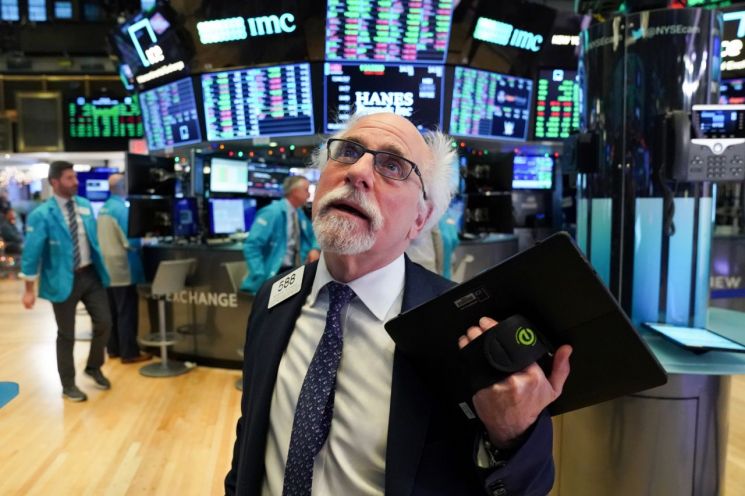
[Asia Economy Reporters Sim Nayoung and Kim Eunbyeol] The global economy, which had shaken off uncertainty following the US-China Phase One trade agreement, has once again been trapped in a 'zero hour.' Although the trade agreement signing is expected to take place within this month and key economic indicators have shown improvement, raising expectations, concerns have emerged that instability in the Middle East could cause the global economy to falter again. On the 6th, stock markets in South Korea, China, and Japan opened sharply lower.
On this day, the KOSPI index opened at 2,154.97, down 0.99% (21.49 points) from the previous trading day, extending its decline to over 1%, and recorded 2,158.57 as of 10 a.m. The KOSDAQ opened at 660.08, down 1.47% (9.85 points) from the previous day, and by 10 a.m., the decline had widened to 2.02%. The Shanghai Composite Index was trading at 3,073.68, down 0.33% from the previous close. The Nikkei average in the Tokyo stock market started trading at 23,319.76, down 336.86 points (1.42%) from the closing price on the 30th of last month.
In the Seoul foreign exchange market on the same day, the won-dollar exchange rate opened at 1,168.1 won, up 1.0 won. The preference for the dollar, which strengthened immediately after the Middle East tensions flared, was mostly reflected in the foreign exchange market on the 3rd. As of 10 a.m. on the 6th, it showed a slight upward trend at 1,167.6 won. Although the won’s value did not plunge immediately causing market turmoil, the prevailing view is that uncertainty has increased due to the US-Iran situation. With progress in the US-China trade dispute creating a so-called 'Risk on' atmosphere in financial markets and recent risk asset preference, this issue has weakened that sentiment again. A Bank of Korea official stated, "Dollar buying sentiment has begun to form again in the foreign exchange market."
If the conflict between the US and Iran escalates further, South Korea’s economy will inevitably suffer damage. The government and the Bank of Korea had projected this year’s economic growth rate at 2.4% and 2.3%, respectively, based on assumptions that last year’s base effects and the global economy would bottom out and recover, but achieving even these targets now seems difficult.
Professor Sung Tae-yoon of Yonsei University’s Department of Economics said, "In addition to the damage already inflicted on the Korean economy by labor costs, if energy costs also increase, industrial competitiveness will weaken," adding, "In the worst case, if the Strait of Hormuz is blocked, the negative repercussions will be much greater."
The global economy has once again slipped into uncertainty. Michael Maloof, a former senior official at the US Department of Defense, appeared on Russian media RT on the 5th (local time) and stated, "Iran could block major transportation routes in the Gulf region following a US attack," adding, "This could cause serious problems not only for the global oil market but also for the global economy." Experts warn that if the conflict between the US and Iran is not resolved, there could be a surge in oil prices, a flight to safe-haven assets, financial market volatility, and a contraction in consumption. Bloomberg reported, "Energy-importing countries may experience reduced household income and spending, and accelerated inflation in the event of a sharp rise in oil prices."
© The Asia Business Daily(www.asiae.co.kr). All rights reserved.

















